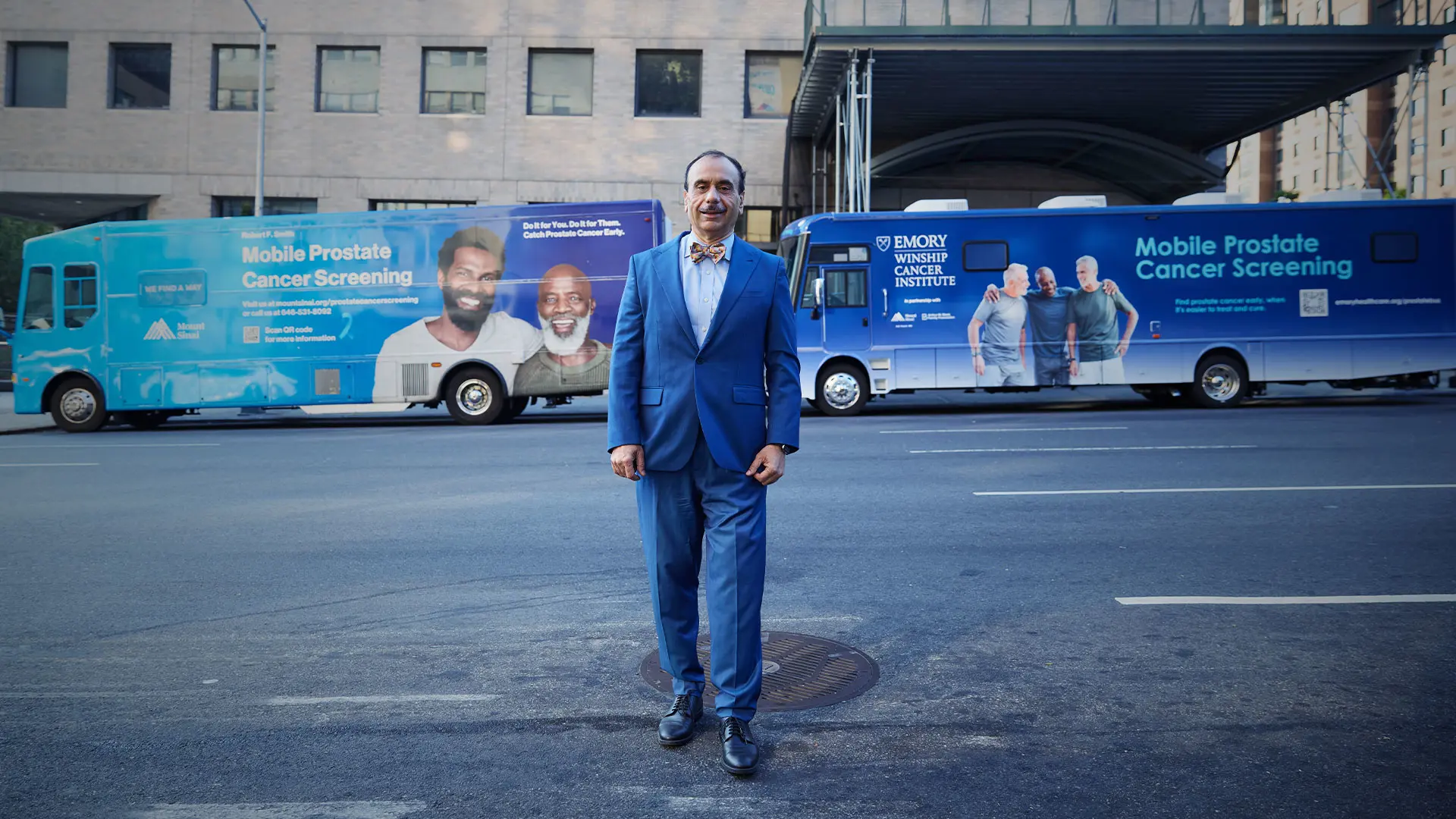
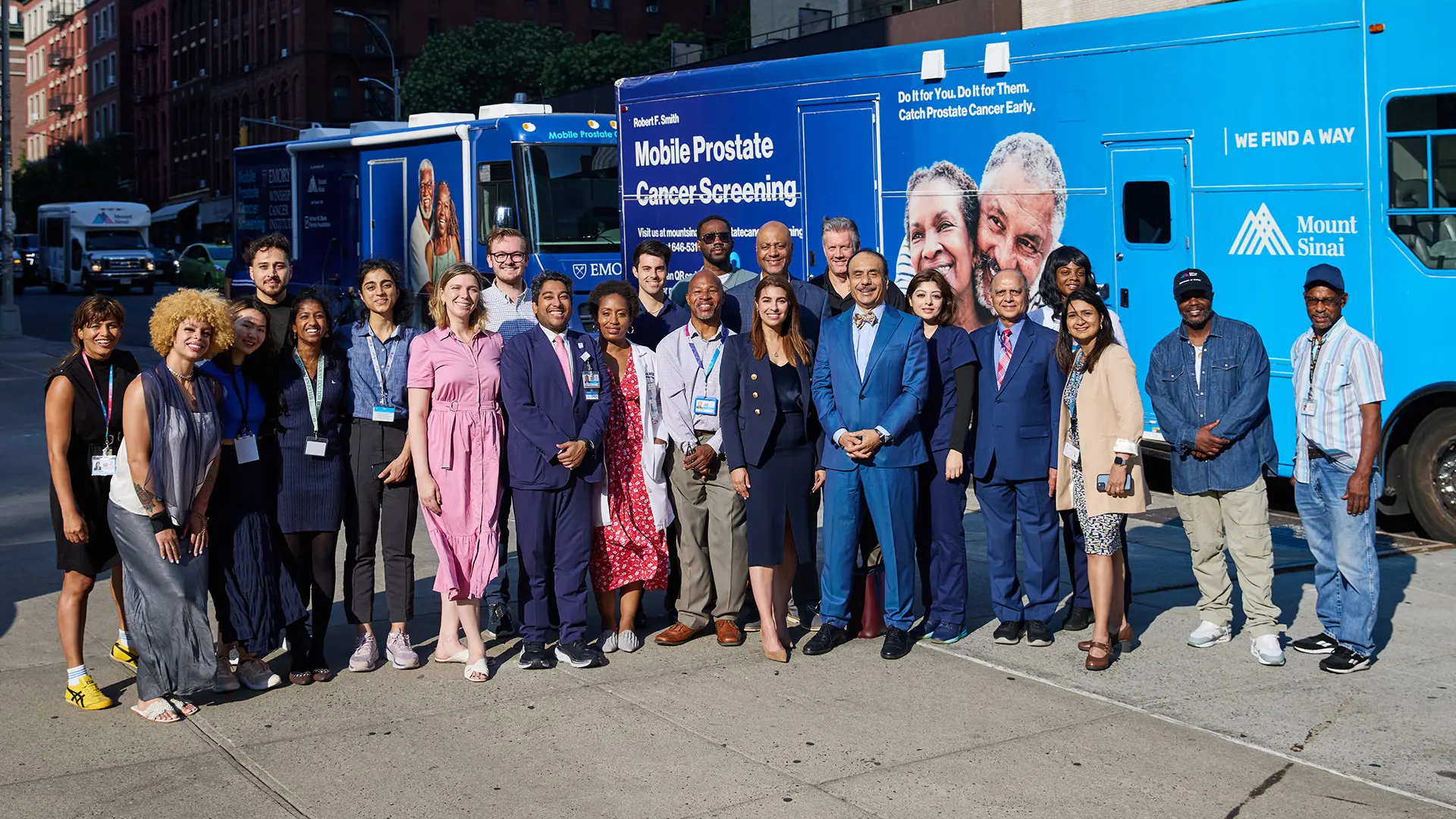
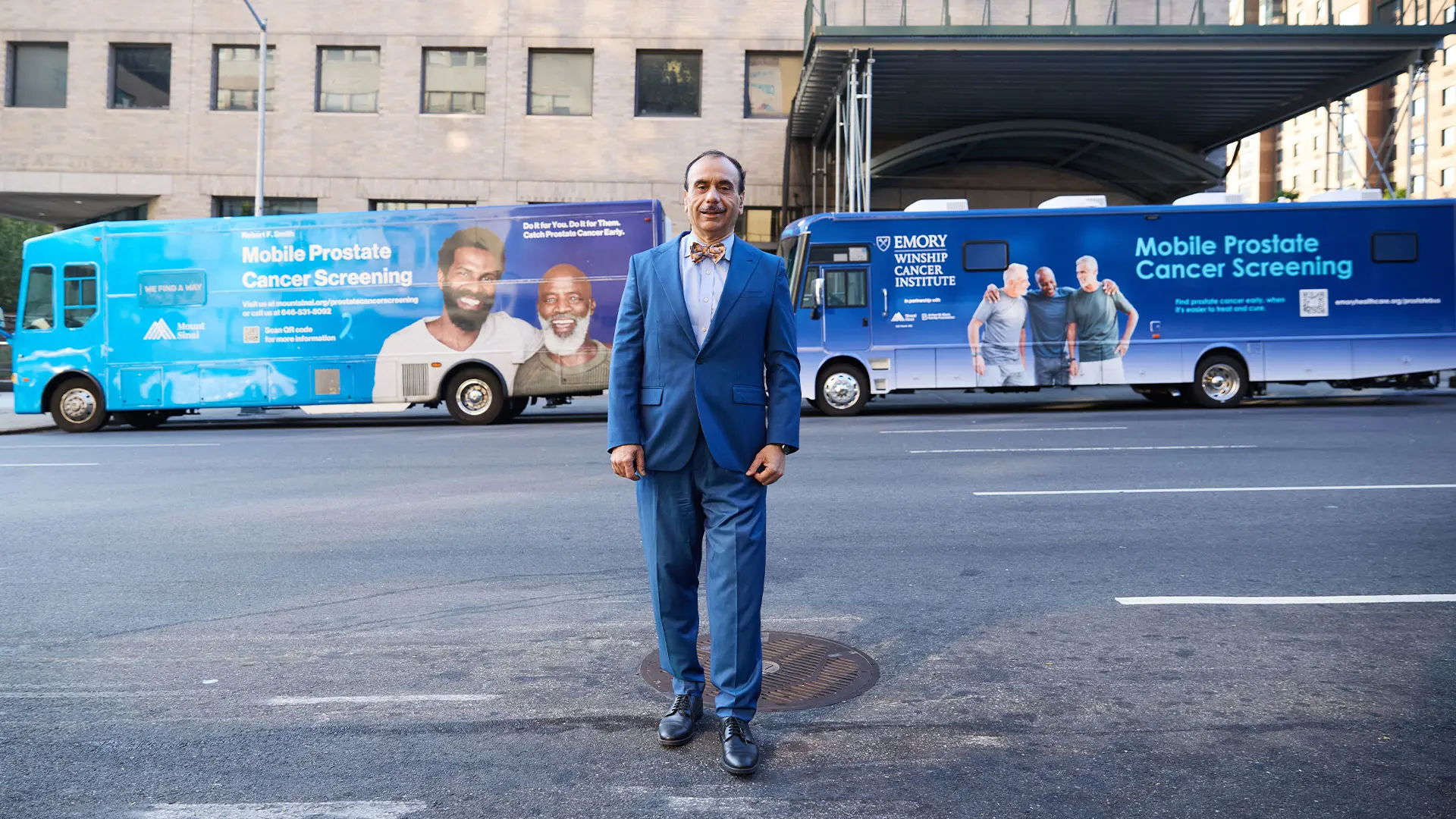
The team from the Mount Sinai Department of Urology stands beside the Mount Sinai Robert F. Smith Mobile Prostate Cancer Screening Unit parked outside of The Mount Sinai Hospital beside the mobile unit that would be launched by the Winship Cancer Institute of Emory University in Atlanta.
The Mount Sinai Robert F. Smith Mobile Prostate Cancer Screening Unit reached two key milestones in 2025 as it continues in its mission to expand testing and care of high-risk men in the community.
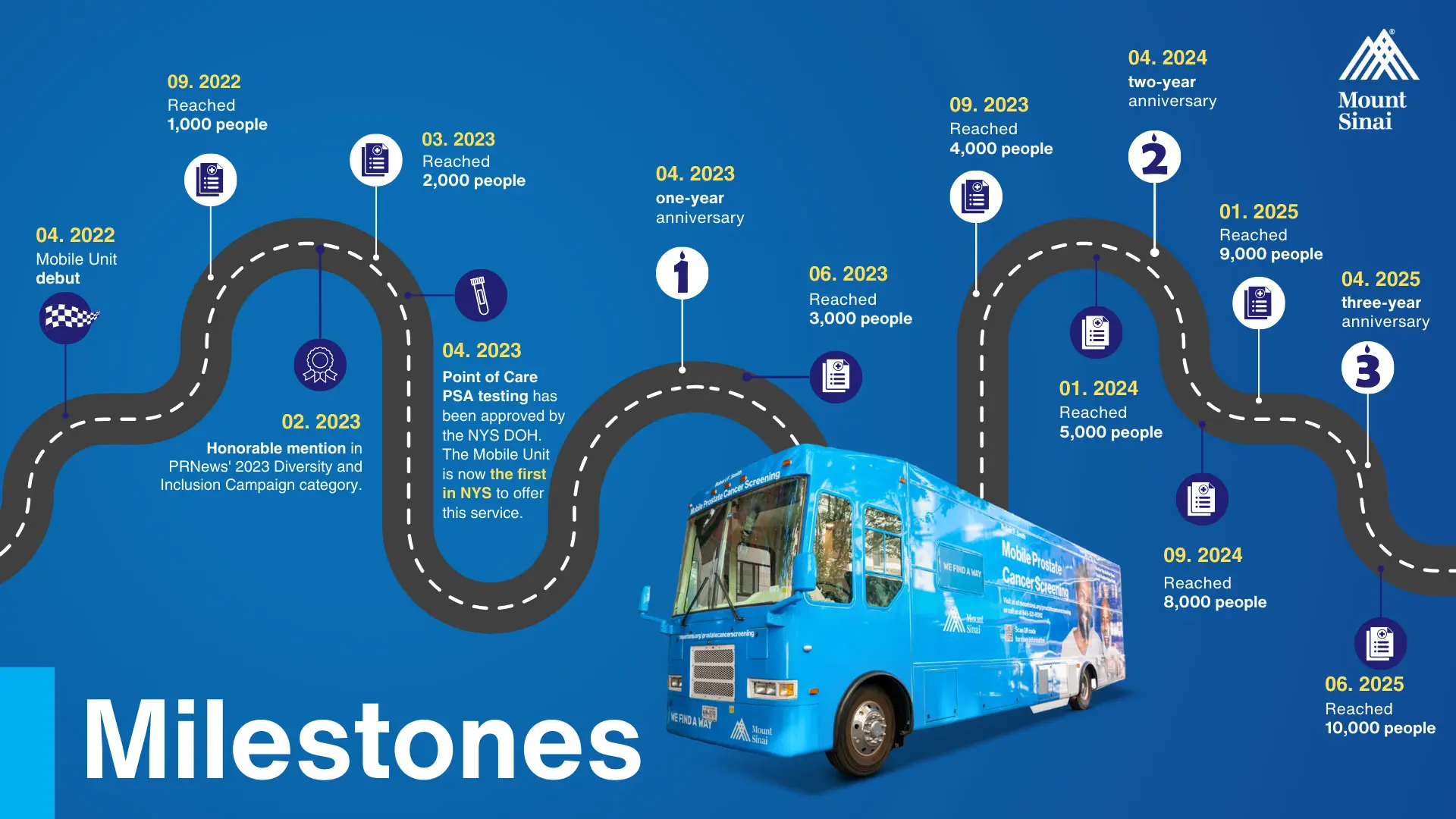
In June of 2025, the unit marked 10,000 people screened for prostate cancer since the unit was launched in April of 2022. And in September, the Mount Sinai team saw its vision to expand service beyond the New York area become a reality with the launch of a mobile unit by the Winship Cancer Institute of Emory University in Atlanta.
The Institute, through generous support from the Arthur M. Blank Family Foundation and in collaboration with the Mount Sinai Health System, celebrated the launch of the new Winship Mobile Prostate Cancer Screening Program at a festive community event inside Mercedes-Benz Stadium in Atlanta with health care leaders, city officials, and local celebrities.
“As a prostate cancer survivor, I know firsthand the life-saving impact and peace of mind that screenings can have on men,” said Arthur M. Blank, owner and chairman, Blank Family of Businesses. “It is an honor for our Family Foundation to partner with Mount Sinai and Winship Cancer Institute of Emory University on this incredible initiative. Our hope is that this mobile unit will stand as a symbol of trust, access, and equity in our community. I pray for all my brothers who face this disease and encourage all men to get screened.”
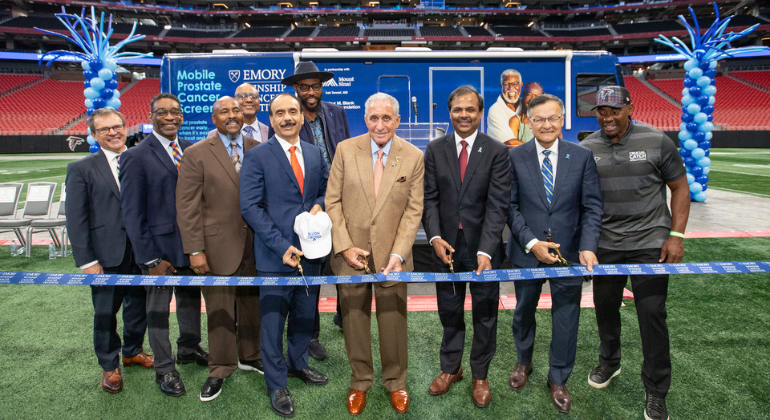
Pictured during launch ceremonies in Atlanta are, from left: Martin Sanda, MD, Milton Little, Herman ‘Skip’ Mason Jr., Kennard Hood, MD, (back row), Ash Tewari, MBBS, MCh, FRCS (Hon.), Dsc (Hon.), Montell Jordan (behind Dr. Tewari), Arthur Blank, Suresh Ramalingam, MD, FACP, FASCO, Joon Lee, MD, and former Atlanta Falcons linebacker Chris Draft. Credit: Emory University
The initiative in Georgia aims to continue the original mission that began with Ash Tewari, MBBS, MCh, FRCS (Hon.), Dsc (Hon.), Kyung Hyun Kim, MD Professor and Chair of the Milton and Carroll Petrie Department of Urology at the Icahn School of Medicine at Mount Sinai: bring accessible initial screenings to men across the state at no cost to them, with a focus on addressing disparities in prostate cancer among those at highest risk, including Black men.
"I founded this initiative to bring prostate cancer screening directly to the communities that need it most,” says Dr. Tewari, who is also Chair of Urology, The Mount Sinai Hospital; Director of the Center of Excellence for Prostate Cancer at the Mount Sinai Tisch Cancer Center, Icahn School of Medicine at Mount Sinai; and Surgeon-in-Chief of the Tisch Cancer Hospital at The Mount Sinai Hospital.
With the initiative now extended to Georgia communities via Winship’s collaboration, the shared commitment to health care among the participating organizations is a “hand-in-hand commitment to rewrite the narrative around prostate cancer for all men across America and the globe,” Dr. Tewari says. “Every screening is a step toward increasing access, raising awareness, and advancing toward our long-term goal of screening one million men. Here’s to the next million miles and the million lives we hope to reach."
In June of 2025, the unit marked 10,000 people screened for prostate cancer since the launch, and in September, the Mount Sinai team saw its vision to expand service beyond New York become a reality with the launch of a mobile unit by the Winship Cancer Institute of Emory University in Atlanta. Watch the video to learn more.
The mobile screening clinic is equipped to provide quick and convenient PSA blood tests—often the first step in detecting prostate cancer—without the need for a full clinical visit. By bringing this service directly into communities, the program aims to reach men who may not otherwise seek care due to work schedules, lack of transportation or misconceptions about screening.
Prostate cancer is the most common cancer among men in the United States, with Black men facing some of the highest incidence and mortality rates. Early detection can dramatically improve survival rates, yet screening participation remains uneven across demographic groups.
The Mount Sinai Robert F. Smith Mobile Prostate Screening Unit was launched by Dr. Tewari and his team with the goal of changing the trajectory of prostate cancer among New York City’s highest at-risk population.
Since then, the easily identifiable sky-blue van has screened more than 12,600 men, up from 1,000 in its first year, while logging more than 25,000 miles across nearly 800 community screening events and sites. About 20 percent of those screened require follow up care.
Funded by a generous $3.8 million donation from philanthropist Robert F. Smith, based on a proposal spearheaded by Dr. Tewari, the Mount Sinai Robert F. Smith Mobile Prostate Screening Unit is dedicated to addressing prostate health disparities.
With a specific focus on educating Black men about prostate health and providing life-saving screenings and referrals for treatment, the initiative aims to reduce prostate cancer deaths among Black males by 25 percent in the communities surrounding The Mount Sinai Hospital and Mount Sinai Queens.
The mobile unit is serving a critical function: bringing needed medical screening and a process of shared decision-making to an underserved community. Collaboration remains key to this effort. By partnering with organizations and the broader medical community, the initiative builds on the program's proven success.
The initiative is guided by a mission to raise awareness, enlighten communities, and prioritize proactive prostate cancer screening while emphasizing shared decision-making that respects patients' values and preferences.
Beyond prostate cancer, the mobile unit serves as a critical gateway to identifying other medical conditions such as incontinence, bladder cancer, and kidney disease—ailments often overlooked in populations with limited access to health care.
“Ideas do change reality,” Dr. Tewari says. “Our vision was very simple: Reaching out to men at the places where they live, where they gather, where they pray. Go right to where they are. We can touch millions.”
As part of its growing outreach, the multidisciplinary team works closely with local churches, health centers, and community organizations to enhance awareness, education, and access to quality care. Alongside the core team, additional Mount Sinai health care providers contribute to the van’s efforts in local neighborhoods, ensuring a broader impact.
“Ideas do change reality,” Dr. Tewari says. “Our vision was very simple: Reaching out to men at the places where they live, where they gather, where they pray. Go right to where they are. We can touch millions.”
Results
750+ community events, 12,000+ patients screened, 25,000+ miles driven