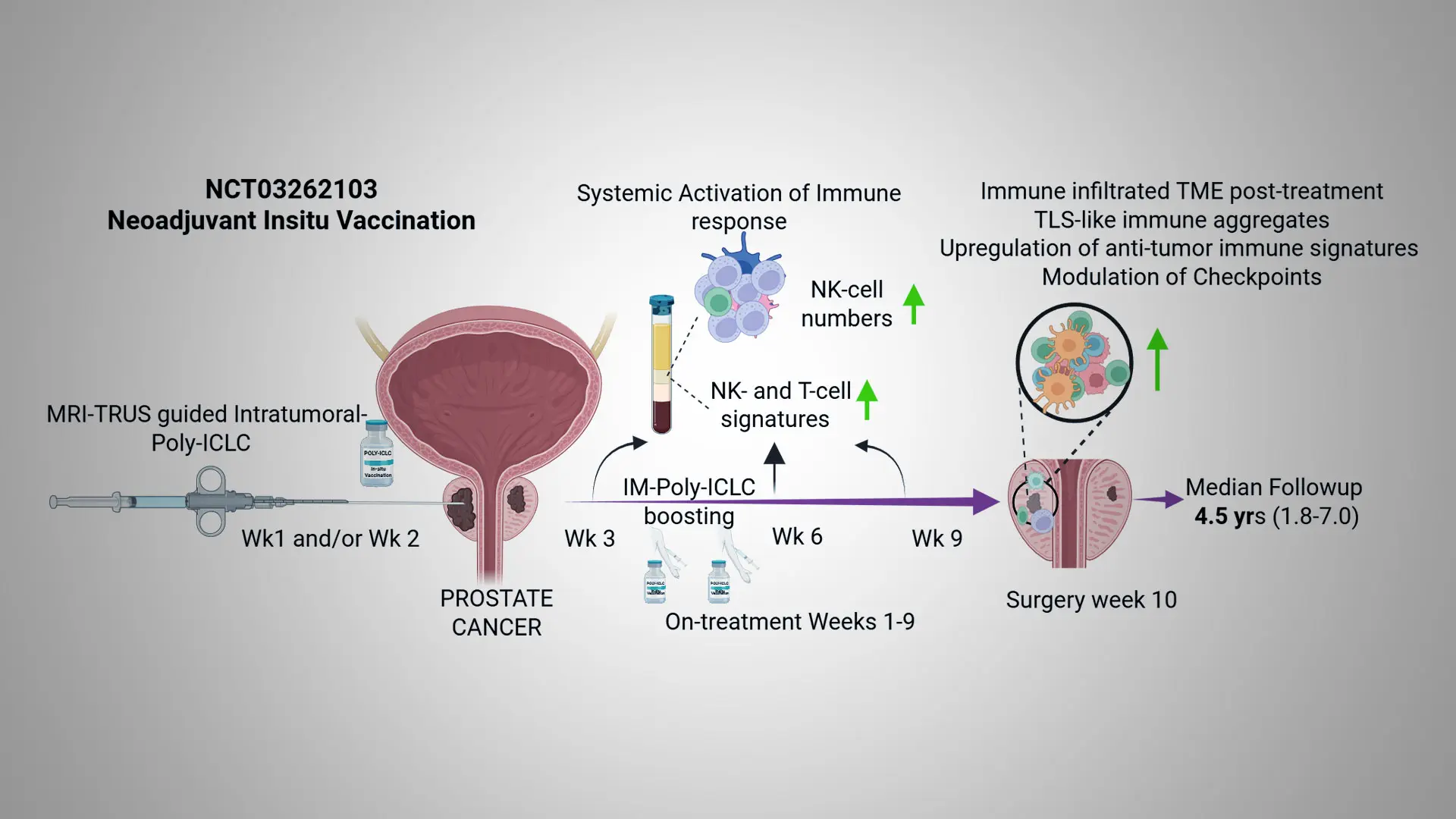
A small, early clinical trial led by the Icahn School of Medicine at Mount Sinai and collaborators has shown that directly injecting an immune-activating compound into prostate tumors before surgery appears safe and may help the immune system recognize and attack cancer cells.
The phase I study tested a viral-mimicking drug called poly-ICLC in 12 men with intermediate- to high-risk prostate cancer. The neoadjuvant treatment was delivered in two doses—first into the tumor to trigger an immune response, then into a muscle to boost it. The goal was to train the immune system to recognize the cancer before it was removed.
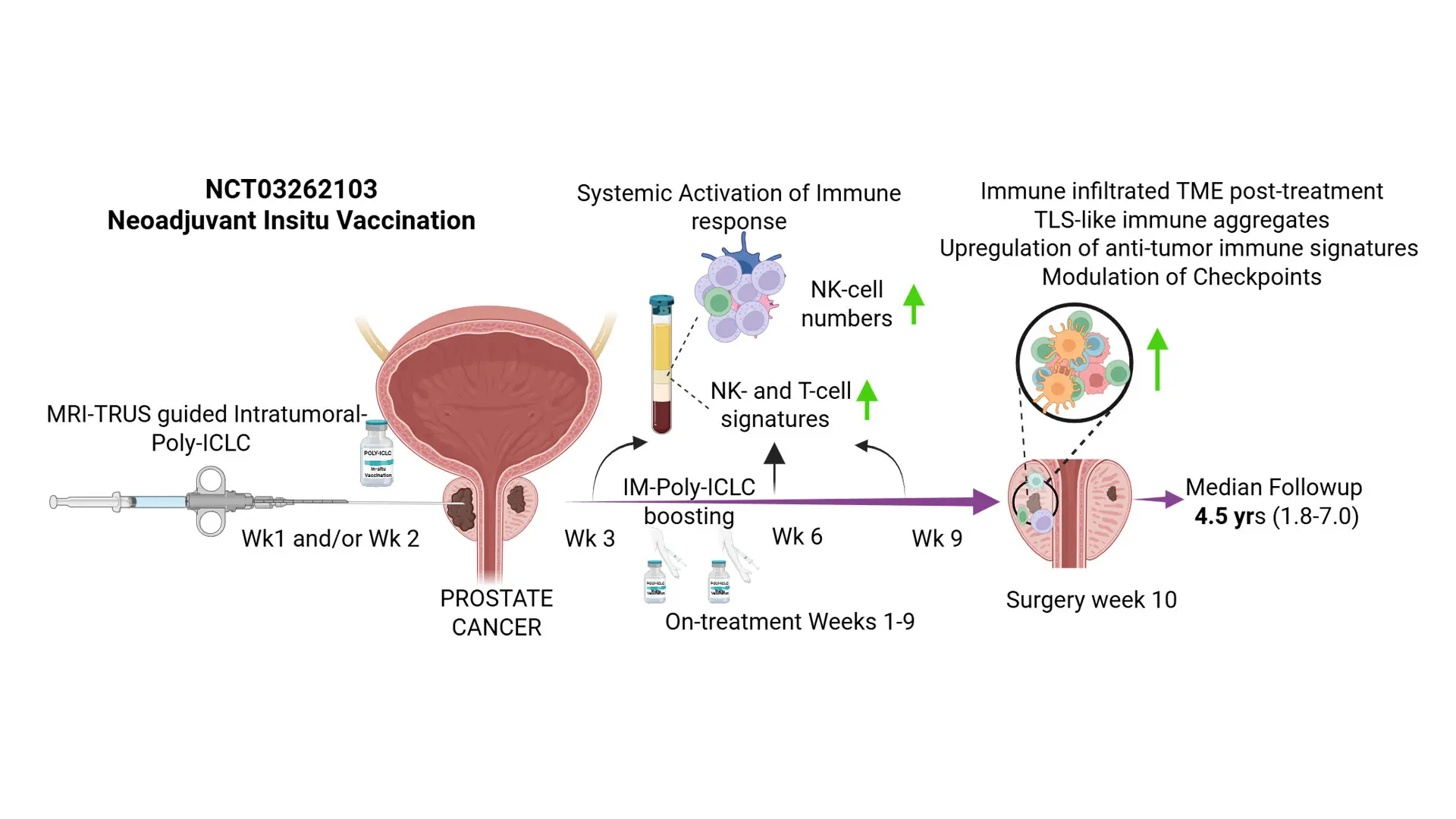
A novel pre-surgery therapy triggered immune responses in prostate tumors and produced encouraging early tumor changes, offering a potential new path for immunotherapy. Image credit: Nair et al., Med
The results of the study were published in the October 30 online issue of Med, a Cell Press journal. The work was funded by the Arthur M. Blank Family Foundation.
Using imaging to guide the injections, researchers delivered the drug into the tumor and then tracked changes in tissue and blood. The therapy was well tolerated and appeared to jump-start immune activity—drawing immune cells into the tumor, shifting gene patterns, and creating small pockets of immune cells where none had been before, say the investigators.
“Our findings provide an important proof of concept that the immune system in prostate cancer can be reawakened,” says physician-scientist Ash Tewari, MD, MBBS, MCh, who led the phase 1 trial and is senior and corresponding author. Dr. Tewari is the Kyung Hyun Kim, MD Professor and Chair of the Milton and Carroll Petrie Department of Urology at the Icahn School of Medicine.
“By delivering poly-ICLC straight into the tumor under MRI–ultrasound fusion guidance, we were able to engage local immunity before surgery. The same approach could be used to inject other immune agents or combinations, opening new paths for targeted treatment in the prostate,” Dr. Tewari says. “If larger studies confirm these results, this tumor-focused ‘autovaccination’ strategy could become an innovative way to make immunotherapy more effective for men with aggressive prostate cancer.”
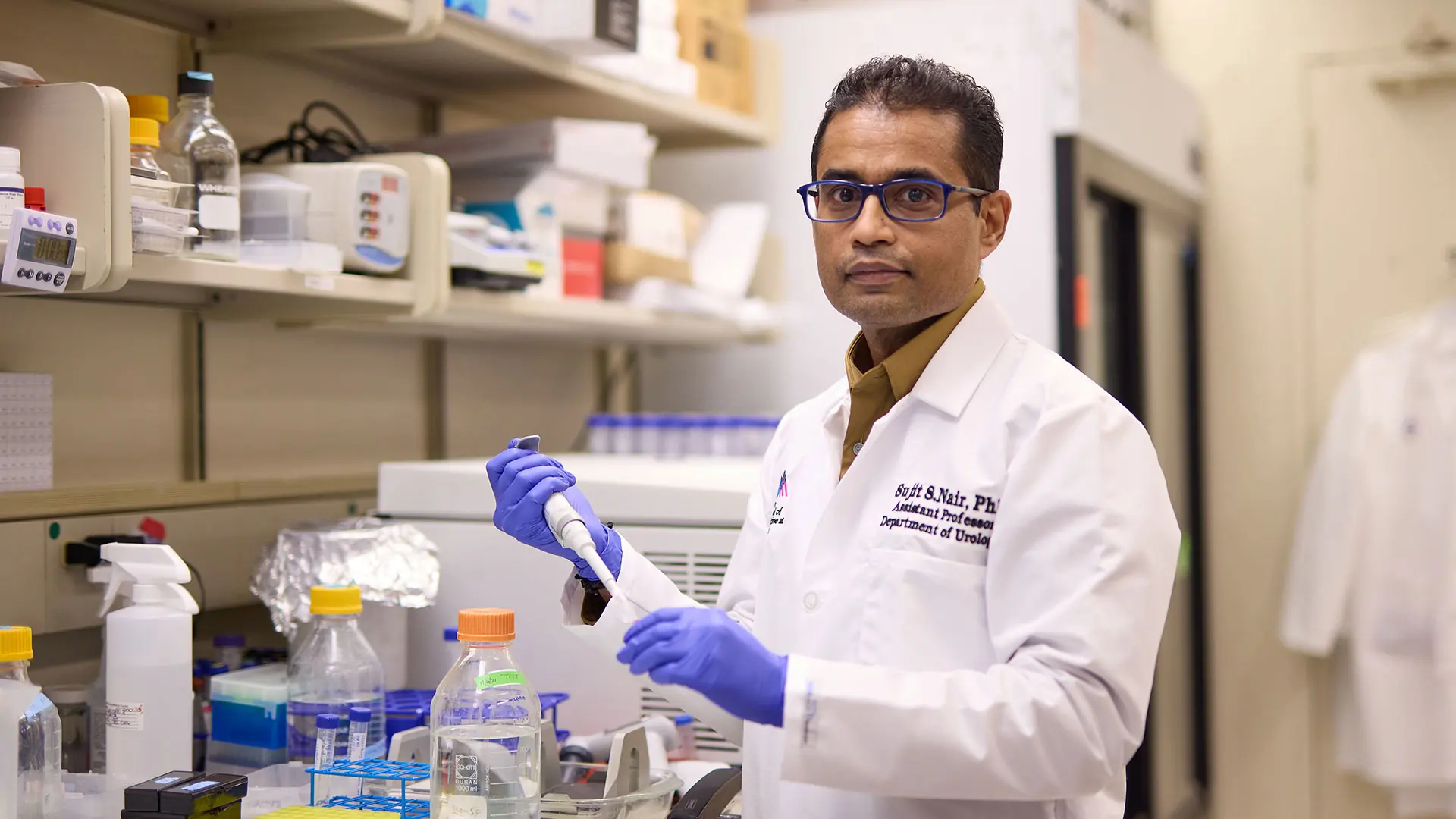
“High-risk prostate cancer often returns after treatment and has been largely resistant to immunotherapy because the tumors don’t naturally trigger strong immune responses,” says Sujit S. Nair, PhD, Assistant Professor and Director of Genitourinary Immunotherapy Research in the Department of Urology at the Icahn School of Medicine.
In addition to showing signs of immune activation, several patients demonstrated favorable early pathology changes following treatment. While the study’s size limits conclusions about long-term outcomes, the findings suggest this strategy could help reprogram “cold” tumors into “immune-active” ones, according to the investigators.
“High-risk prostate cancer often returns after treatment and has been largely resistant to immunotherapy because the tumors don’t naturally trigger strong immune responses,” says lead and corresponding author Sujit S. Nair, PhD, Assistant Professor and Director of Genitourinary Immunotherapy Research in the Department of Urology at the Icahn School of Medicine.
“We wanted to test whether we could safely ‘warm up’ these tumors by activating the immune system before surgery, and the early signals are encouraging,” Dr. Nair says. “To our knowledge, this is the first prostate cancer trial to test intratumoral immunotherapy. Our method doesn’t rely on a single tumor target and trains the immune system to recognize the whole tumor.”
The results provide a basis for testing how this approach might be combined with standard or experimental immunotherapies in future trials.
“The idea of transforming a tumor into its own vaccine by locally stimulating immune recognition is one of the most exciting directions in cancer research,” says corresponding author Nina Bhardwaj, MD, PhD, Ward-Coleman Chair in Cancer Research, and Director of the Vaccine and Cell Therapy Laboratory at the Icahn School of Medicine. “This work shows that even tumors once thought to be invisible to the immune system can potentially be made responsive.”
Next, the research team plans to move forward with larger, controlled phase 2 clinical trials to test clinical benefit and explore combination strategies with hormone therapies or other immunotherapies. They will also study how this approach reshapes the tumor–immune relationship over time and whether it can help identify which patients are most likely to benefit.
The paper is titled “Prostate cancer in situ autovaccination with the intratumoral viral mimic poly-ICLC: Modulating the cold tumor microenvironment.”
The study’s authors, as listed in the journal, are, from Mount Sinai: Sujit S. Nair, Dimple Chakravarty, Sreekumar Balan, Swati Bhardwaj, Tin Htwe Thin, Monica Garcia-Barros, Kenneth Haines, Majd Al Shaarani, Rachel Weil, Marcia Meseck, Parita Ratnani, Monali Fatterpekar, Elena Gonzalez-Gugel, Adam Farkas, Vinayak Wagaskar, Ivan Jambor, Kacie Schlussel, Cristina Pasat-karasik, Kamala Bhatt, Zachary Dovey, Adriana Pedraza, Akriti Gupta, Dara Lundon, Ante Peros, Sneha Parekh, Lily Davenport, Xiangfu Zhang, Raghav Gupta, Macy Robison, Cynthia Knauer, Ethan Ellis, Dmitry Rykunov, Boris Reva, Babu Padanilam, Matthew D. Galsky, Rachel Brody, Mani Menon, Nina Bhardwaj, and Ashutosh K. Tewari. Other authors listed are: Alexander Hakansson, Manuel Duval, Elai Davicioni, Yang Liu, and Andres M. Salazar.