
In May 2026, Mount Sinai launched the Carolyn Rowan Center for Women’s Health and Wellness, a new academic clinical center designed to reimagine how women experience care across the lifespan. The Center brings together holistic specialty care, evidence-based strategies, and clinical research within a single, coordinated model—moving beyond episodic treatment toward personalized, longitudinal care.
The Rowan Women’s Health Center—located on The Mount Sinai Hospital campus on the Upper East Side of Manhattan—is both coordinated and comprehensive. Women have access to expertise in obstetrics and gynecology, cardiology, endocrinology, gastroenterology, orthopedics, nutrition, behavioral health, pelvic floor physical therapy, and sexual medicine, along with advanced diagnostics including bone density and body composition assessment, advanced gynecologic ultrasound, and cardiometabolic risk evaluation, all under one roof. Gynecologic subspecialty care includes menopause and hormonal medicine, sexual medicine, gynecologic surgery, and urogynecology.
What fundamentally distinguishes the Center, however, is not only the breadth of services offered, but also how care is delivered.
Care Organized Around Clinical Pathways
Rather than navigating a series of disconnected appointments, many women who come to the Rowan Women’s Health Center will be matched to a clinical care pathway—a curated, time-limited, and goal-oriented care experience centered on a specific life stage or health theme. These pathways are intentionally designed to address symptoms, underlying physiology, and future health risks through a coordinated sequence of visits and services across specialties.
The first of the pathways, MyPath Balance 40+, provides comprehensive care for perimenopausal and menopausal women. MyPath Moms, focused on postpartum care, will be available in September 2026. Other pathways under development include whole-person care for women over 60, care for women with chronic pelvic pain including endometriosis, and survivorship care for breast and gynecologic cancers. Each pathway begins with a comprehensive assessment, integrates medical and supportive services, and concludes with a structured transition back to a woman’s primary care team.
“The Center offers a special and unique way of providing care given the fragmentation of the current health care system and the difficulty both patients and providers have navigating it,” says Anna Barbieri, MD, Clinical Strategy Leader for the Rowan Women’s Health Center and a longtime specialist in menopause and integrative medicine. “The Center acts as a hub that ties together integrated, personalized care and education in terms of health literacy and empowerment for each woman. Traditionally, this type of holistic approach has only been available to a few people. We want to extend it to many more women, and make it a model for health care delivery across the country.”
Navigation itself has become one of the most significant barriers to effective care, particularly for women with complex or overlapping needs. At the Center, dedicated navigators and pathway-based care teams assume responsibility for coordinating care, reducing the burden on patients to manage referrals, appointments, and disconnected treatment plans.
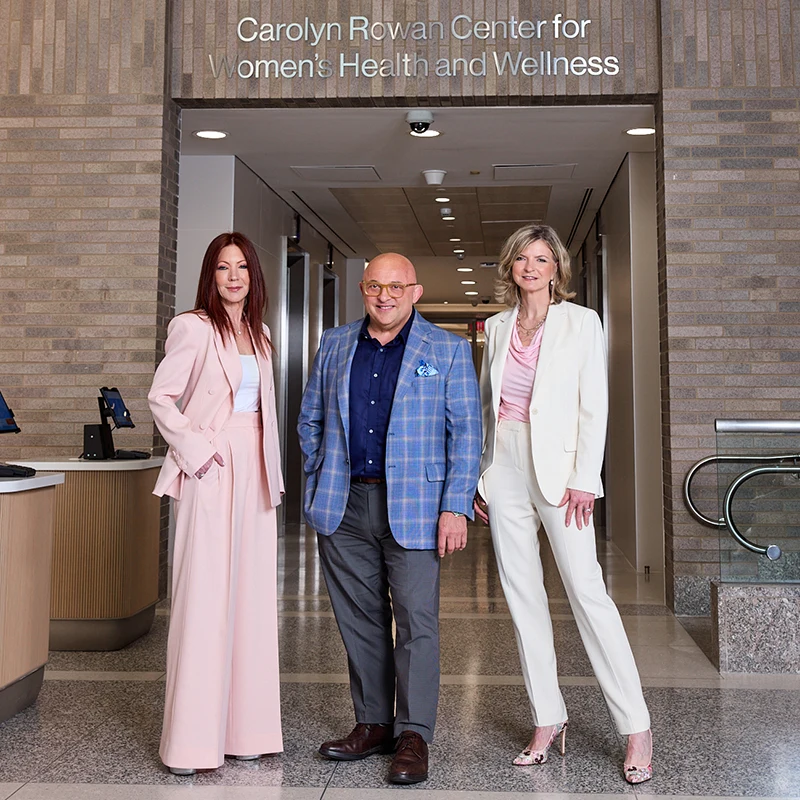
From left, Joanne Stone, MD, the Ellen and Howard C. Katz Chair in Obstetrics, Gynecology and Reproductive Science; Francesco Callipari, MD, Medical Director of the Carolyn Rowan Center for Women's Health and Wellness; and Anna Barbieri, MD, Clinical Strategy Leader of the Center.

An important element of the Carolyn Rowan Center for Women's Health and Wellness is the environment itself, which is designed to be a welcoming, spacious, and calming space.
A Focus on Healthspan and Prevention
The philosophy of the Rowan Women’s Health Center extends beyond the treatment of diagnosed disease. A central goal of the Center is to identify and modify risk factors early—particularly during key biological transitions—to improve long-term health outcomes and extend healthspan, the number of years a person lives in good health.
“The goal is not to intrude on any relationship the patient may have with a primary obstetrician, gynecologist, or other physician outside our hospital,” says Joanne Stone, MD, MS, the Ellen and Howard C. Katz Chair in Obstetrics, Gynecology and Reproductive Science. “In these cases, we are committed to providing the best possible care for patients, then managing the handoff back to their regular doctor at the completion of our program.”
Women may also come to the Rowan Women’s Health Center for a single specialized service—such as a bone density scan, advanced gynecologic ultrasound, or urogynecology consultation prior to surgery—while benefiting from the Center’s integrated expertise and coordinated communication.

Anu Lala, MD, a nationally ranked cardiologist, is among the specialists available at the Carolyn Rowan Center for Women's Health and Wellness.
Midlife Care as a Pivotal Opportunity
A cornerstone of the Center’s work is perimenopause and menopause medicine, a historically understudied and often fragmented area of care.
“Menopause doesn’t currently have a home at most institutions,” Dr. Barbieri says. “Is it OB/GYN, or endocrinology, or partly cardiology? In reality, it’s all of these and more, which is why we want to put them together in the form of a serious and informed discussion with women about the most appropriate approaches and therapeutics to manage the symptoms and consequences of menopause.”
The Center’s midlife hormonal and cardiometabolic pathway addresses symptoms such as disrupted sleep, low libido, weight gain, hot flashes, and mood changes, while simultaneously assessing blood pressure, lipid levels, metabolic health, and bone density. This approach recognizes midlife as a critical window to influence future cardiovascular, metabolic, skeletal, and cognitive health—not simply a time for symptom relief.
“Our goal is to have women feeling their best in the years before, during, and after menopause,” Dr. Barbieri adds.
Postpartum Care That Looks Forward
The Rowan Women’s Health Center also redefines postpartum care by viewing pregnancy and delivery as early indicators of future health risk. For women who experience complications such as hypertensive disorders of pregnancy, gestational diabetes, or preterm delivery, postpartum care becomes an opportunity for early intervention rather than delayed recognition of risk.
One example is a woman who delivers preterm by emergency Cesarean birth due to preeclampsia and continues to experience elevated blood pressure postpartum. Within the Center’s 24-week postpartum pathway, care would include pelvic floor physical therapy, behavioral health support, cardiometabolic risk assessment, and long-term risk reduction strategies—connecting obstetric outcomes to future cardiovascular health.

Leslee Shaw, PhD, Director of the Blavatnik Family Women’s Health Research Institute
Integrative Strategies and Embedded Research
Traditional medical care at the Rowan Women’s Health Center is complemented by evidence-based integrative strategies, including nutrition counseling, physical therapy, and mind-body practices, all prescribed within structured pathways rather than offered as optional add-ons. The Center is also developing services such as acupuncture, Pilates and yoga classes, and educational events.
An equally important differentiator is the Center’s deep integration with clinical research. “The breadth and depth of our women’s program have never been offered before in an academic medical center, or in such a unified way,” says Francesco Callipari, MD, Medical Director of the Rowan Women’s Health Center. “Patients are shepherded through each step of our clinical care pathways, and we collect data at the start and completion of their journey so we can show outcomes and the improvements they have made.”
The Rowan Women’s Health Center embeds research directly into real-world care, enabling the study of both disease and care delivery models, and accelerating the translation of evidence into practice. Leslee Shaw, PhD, Director of the Blavatnik Family Women’s Health Research Institute, says, “We are revealing connections across adolescence, pregnancy, menopause, and beyond to inform care that helps women realize their fullest definition of health.”
A New Model for Women’s Health
Named for philanthropist Carolyn Rowan, a member of the Mount Sinai Boards of Trustees, the Center reflects a commitment to compassionate, comprehensive, and forward-thinking care. “Imagine a center for women where you know you’re getting the best care, where all of the best doctors are focused on you, and every interaction comes from a place of caring,” Ms. Rowan says.
An important final element, Dr. Stone notes, is the environment itself: a welcoming, spacious, and calming space designed to support connection, empowerment, and partnership. “We are truly changing the paradigm of women’s care through the Carolyn Rowan Center for Women’s Health and Wellness—not telling patients what to do, but partnering with them to arrive at a thoughtful plan for wellness and treatment that maximizes their long-term health.”