Developed by Precision Neuroscience, the device is a flexible, high-density cortical electrode array containing 1,024 individual electrodes designed to be placed directly on the cortical surface for long-term monitoring.
According to Dr. Bederson, the device was implanted in a 38-year-old female patient who had no neurological or motor deficits but was undergoing surgery for a large meningioma located directly over the motor and sensory areas of the brain that was causing significant compression of the eloquent motor cortex.
Although neurologically intact at presentation, the patient had a history of seizures that included right-sided motor twitching and sensory abnormalities. Following tumor resection, the array was placed over the primary motor cortex and left in place for three days to postoperatively monitor for seizures. Dr. Bederson is the Leonard I. Malis, MD/Corinne and Joseph Graber Professor of Neurosurgery, and Chair of the Department of Neurosurgery for the Mount Sinai Health System.
In a video presentation of the case, Dr. Bederson demonstrates how the electrode array was positioned along the cortical surface over the primary motor area and how neural signals were captured, recorded, and interpreted as the patient performed both simple and complex tasks.
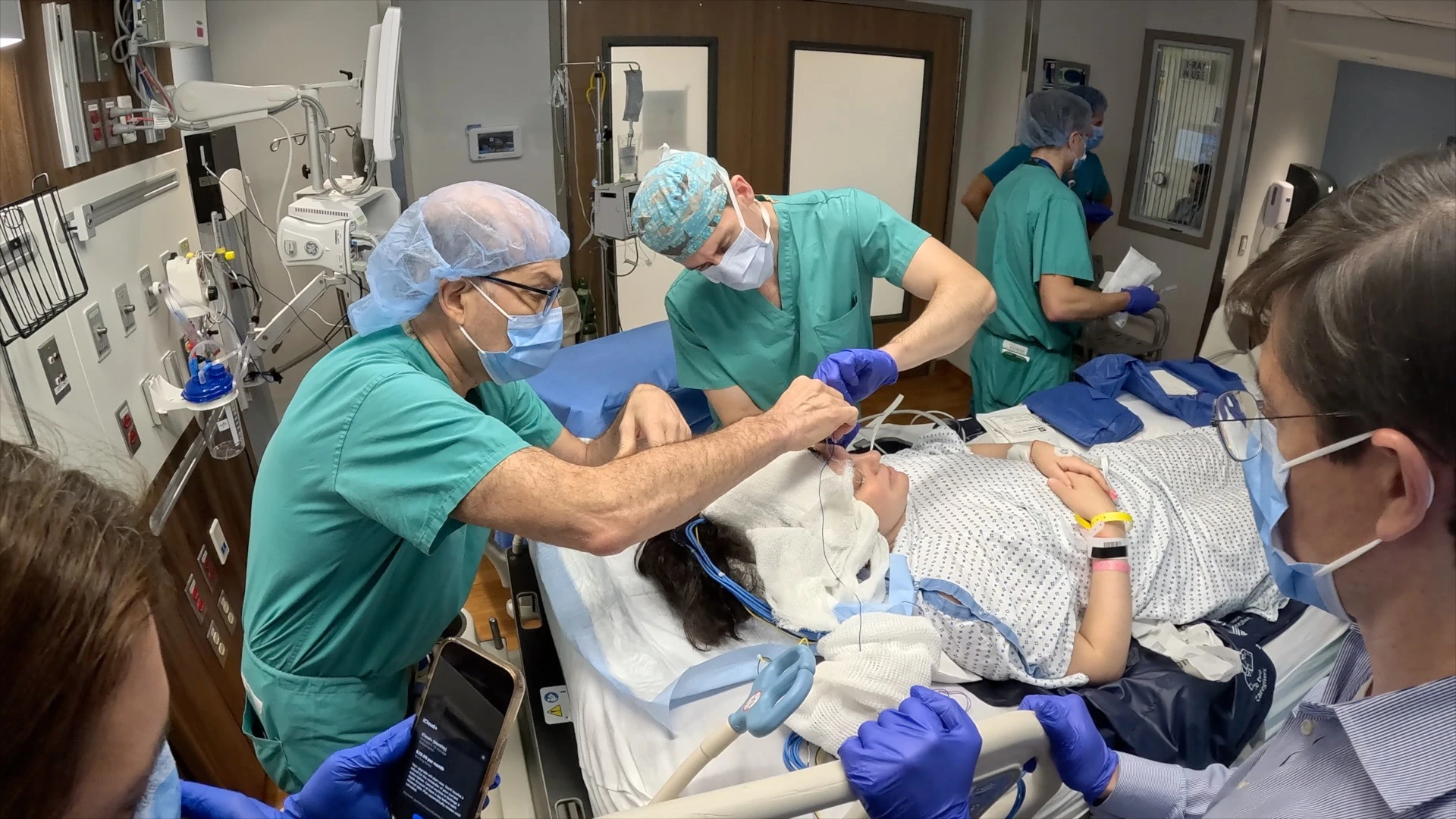
After monitoring for several days, the team was able to safely remove the electrode from the patient at bedside.
“One of the most important advances is the concept that we are able to safely remove the electrode at the bedside,” he says. “Overall, this was a very exciting case for the patient and for the team. She has fully recovered to remain seizure-free. For us, this proved the point that high-resolution postoperative recordings in an awake patient can be used to decode motor function over a very short time span. We feel this is very promising for the future of brain-computer interface.”
Watch video here:
In a world first, Mount Sinai neurosurgeons implanted a next-generation brain-computer interface device during brain surgery, monitored brain activity for several days, and successfully mapped brain function postoperatively.
Dr. Bederson is Chair for the Department of Neurosurgery at the Mount Sinai Health System. Physician-scientist Benjamin I. Rapoport, MD, PhD, is a faculty member in the Department of Neurosurgery. Dr. Bederson serves in a supervisory role for him within the Health System. Dr. Rapoport is an equity owner in Precision Neuroscience, serves as its Chief Science Officer, and is a member of its board of directors. Neither Dr. Bederson nor Mount Sinai has a financial interest in Precision Neuroscience. All Precision Neuroscience research at Mount Sinai is conducted by investigators without financial ties to the company.