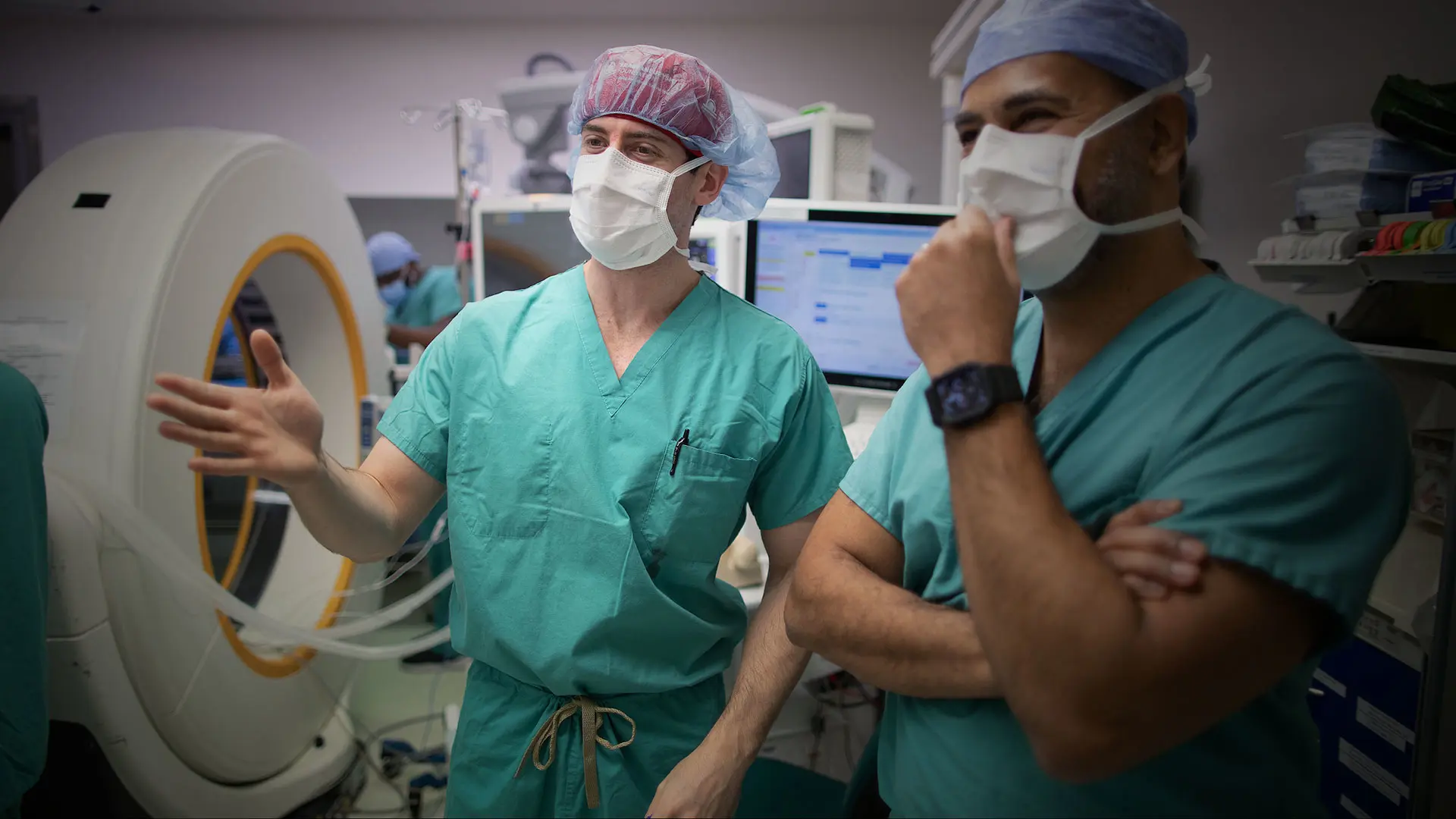
As Co-Chief Resident of the Neurosurgery Residency Program at the Icahn School of Medicine at Mount Sinai, he applies that same action-oriented attitude to his medical career.
“Neurosurgical training, similar to endurance sports, demands persistence, an indomitable spirit, and total command over mind and body,” Dr. Schüpper says. That ability to push through obstacles serves him as well in the operating room as it does on a mountain peak. “No matter the amount of sleep deprivation or how suboptimal my physical state may be, technical excellence is always the expectation,” he adds.
Dr. Schüpper was in high school in the Philadelphia area when a close family friend was diagnosed with glioblastoma, an experience, he says, that motivated him to arrange to spend a summer doing neurosurgery research on glioblastomas at the nearby University of Pennsylvania. “I interacted with neurosurgeons and shadowed them in the operating room,” he says. “It cemented my desire to become a neurosurgeon.”
He continued his neurosurgery research as an undergraduate at Johns Hopkins University, where he majored in neuroscience and psychology. After completing medical school at the University of California San Diego School of Medicine, he was thrilled to match with the neurosurgery residency program at Mount Sinai.
The program stood out for its flexibility, he says. Unlike more traditional programs that follow a set schedule, the curriculum at Mount Sinai is tailored to each resident. Each trainee engages in different elective offerings at different times, an approach customized to individual clinical and research interests. “There’s so much flexibility in the academic opportunities and endeavors we can pursue,” he says.
For Dr. Schüpper, those opportunities led him to specialize in complex spinal deformities in pediatric and adult patients. During his residency training, he arranged to complete a fellowship in pediatric spine surgery at Shriners Children’s in Philadelphia—another testament to Mount Sinai’s flexible and individualized approach to education, he says. After he graduates from Mount Sinai in June 2026, he will begin a yearlong fellowship in adult complex spine surgery at the Barrow Neurological Institute in Phoenix.
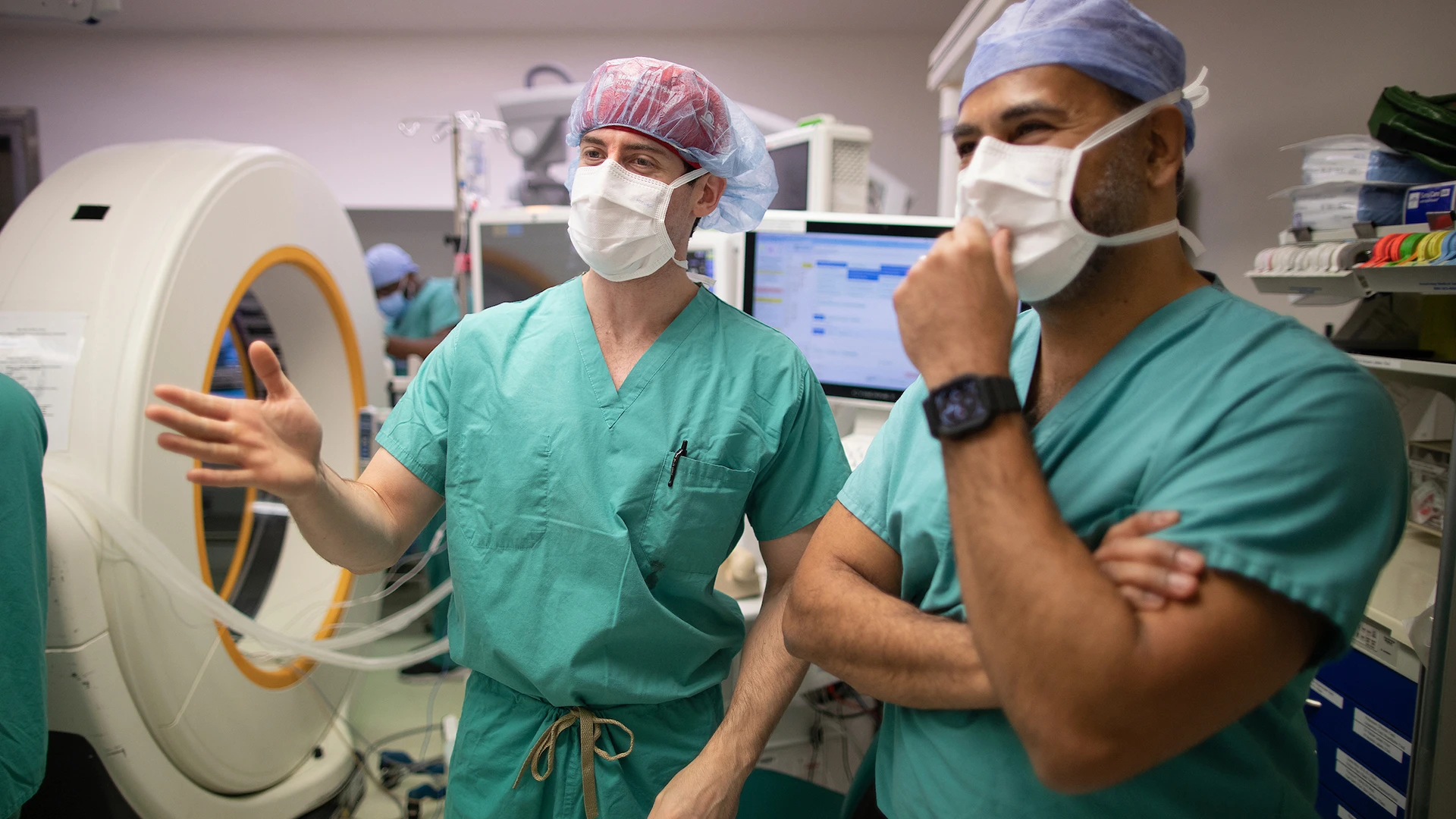
Alexander Schüpper, MD, left, with Raj K. Shrivastava, MD
“Alex is a true academic superstar,” says Raj K. Shrivastava, MD, Professor and Vice Chair for Education, and Neurosurgery Residency Program Director, Department of Neurosurgery. “He distinguished himself very early in our residency as someone who not only did well clinically but was able to execute complex research projects throughout his training. Dr. Schüpper has strong leadership skills and is a great teacher and mentor to his junior residents, and I am sure he will develop into a true academic leader in our field.”
Advancing Neurosurgery Through Research and Innovation
During his residency, Dr. Schüpper engaged in a variety of basic science and clinical research projects. In 2022, he received a two-year, $150,000 grant from the Andrew McDonough B+ Foundation for his research project, “Preclinical Evaluation of BRD Inhibitors to Treat Posterior Fossa A Ependymoma.” He conducted the research, exploring viral vector delivery of treatments for ependymomas, in the laboratory of Oren Becher, MD, Chief of the Jack Martin Fund Division of Pediatric Hematology-Oncology at the Mount Sinai Kravis Children’s Hospital.
Dr. Schüpper has also conducted research on surgical options for adolescents with scoliosis. In a retrospective cohort study published in Spine, he and his colleagues concluded that lumbar anterior vertebral body tethering is a viable treatment option for skeletally immature patients with idiopathic scoliosis. In another retrospective study published in Spine Deformity, he and his colleagues determined that bilateral vertebral body tethering was a safe and potentially viable option for treating young patients with double curves.
“Mount Sinai had everything I was looking for ... a clinically busy program in a large urban area ... complemented by research opportunities that allowed me to pursue my interests and set me up for the career I dreamed of.”
— Alexander Schüpper, MD
Other grants and honors include a $65,000 grant from the brain cancer nonprofit StacheStrong in 2021 for research on the glioma “connectome,” and in 2024, he received the Kuntz Scholar Award, presented to top-scoring abstracts at the annual Spine Summit Meeting. Twice, he received the Icahn School of Medicine’s Kalmon D. Post, MD, Neurosurgery Resident Publication Award, which recognizes excellence in neurosurgical research and publication.
Dr. Schüpper also has a strong personal interest in global health. He travels to Dar es Salaam, Tanzania, each year to help run a scoliosis camp that provides surgical intervention to children with spinal deformities. “There are no scoliosis surgeons in Tanzania, and most families cannot afford to travel for care. We provide the surgical treatments that can dramatically improve their quality of life,” he says.
As Dr. Schüpper wraps up his residency experience, he remains enthusiastic about the ever-evolving field of neurosurgery. “I’m optimistic that advances such as machine learning and robotics and even brain-computer interfaces will continue to improve outcomes in the operating room and make neurosurgery safer,” he says. “Neurosurgery is special in the way it so easily embraces and adapts to innovations.” Nowhere is that more evident than at Mount Sinai, he says, which counts multiple inventors among its neurosurgery faculty—and where the institutional incubator Mount Sinai BioDesign helps physician-scientists bring their medical innovations to life.
That commitment to advancing the field, combined with the depth and breadth of neurosurgical expertise, helps make the residency program a national leader in neurosurgical training, Dr. Schüpper says. “Mount Sinai had everything I was looking for in a residency program: a clinically busy program in a large urban area where I knew I would be exposed to everything neurosurgery offers. Those clinical opportunities were complemented by research opportunities that allowed me to pursue my interests and set me up for the career I dreamed of,” he says. “It has been a privilege to train at Mount Sinai, and finishing my residency will be bittersweet.”