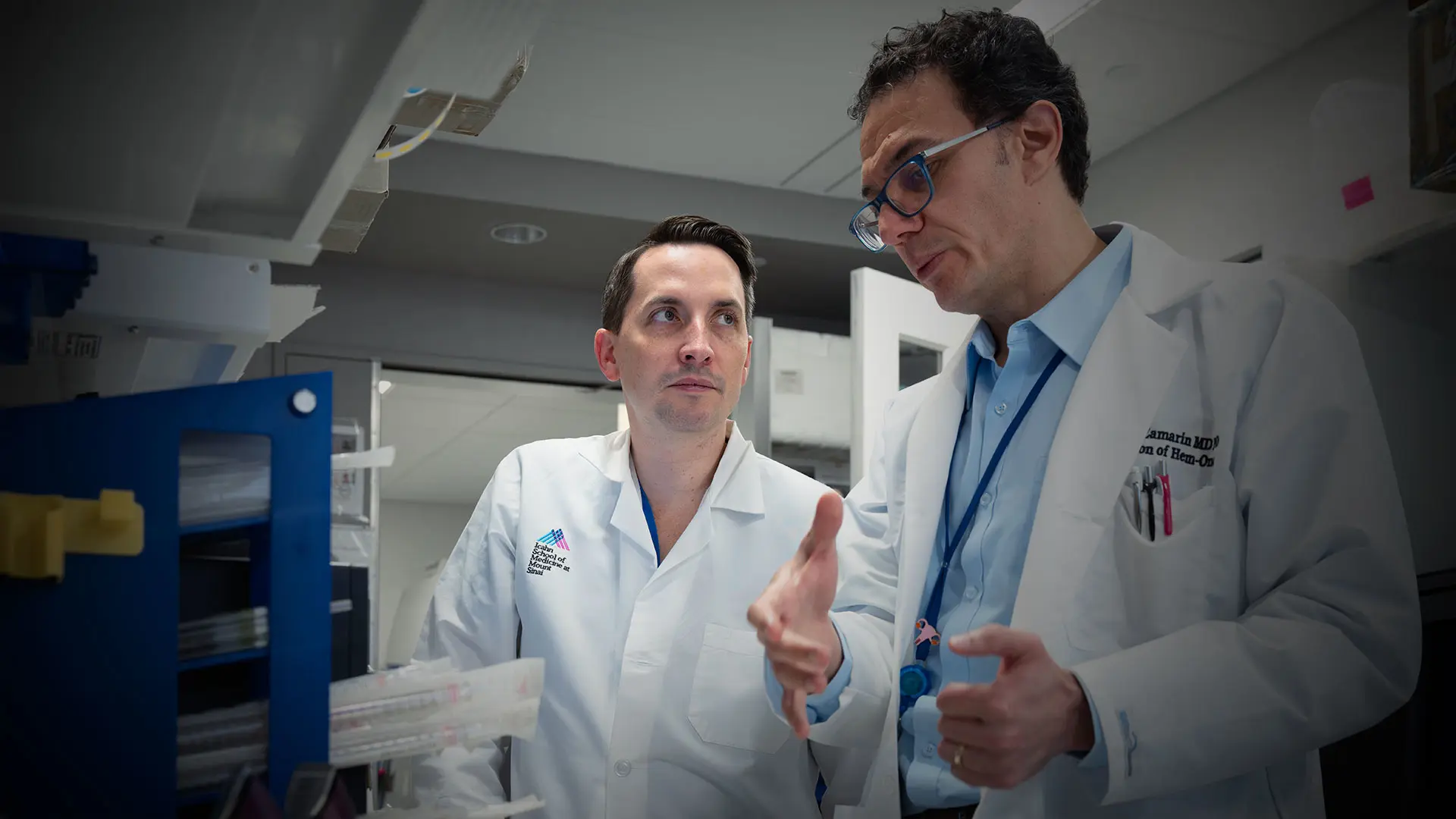
Dr. Craig is pursuing a Master of Science in Biomedical Data Science and AI (MDSAI) at Mount Sinai’s Graduate School of Biomedical Sciences alongside his fellowship to simultaneously strengthen his clinical training and research skills.
"While searching for fellowships, I focused on places that also had graduate programs in computational sciences," he explains. The Icahn School of Medicine stood out for its dedicated MDSAI program and numerous labs focused on projects with a strong data science component.
For his fellowship training, Dr. Craig joined the lab of physician-scientist Dmitriy Zamarin, MD, PhD, Professor of Medicine (Hematology and Medical Oncology), who leads the Gynecologic Medical Oncology section. Dr. Craig started graduate school classes along with his fellowship research immediately upon arrival in 2024.
The Raquel and Jaime Gilinski Department of Obstetrics, Gynecology and Reproductive Science at Mount Sinai "not only supported my decision to pursue the degree but also funded it, reflecting a clear commitment to advancing this kind of training," says Dr. Craig.
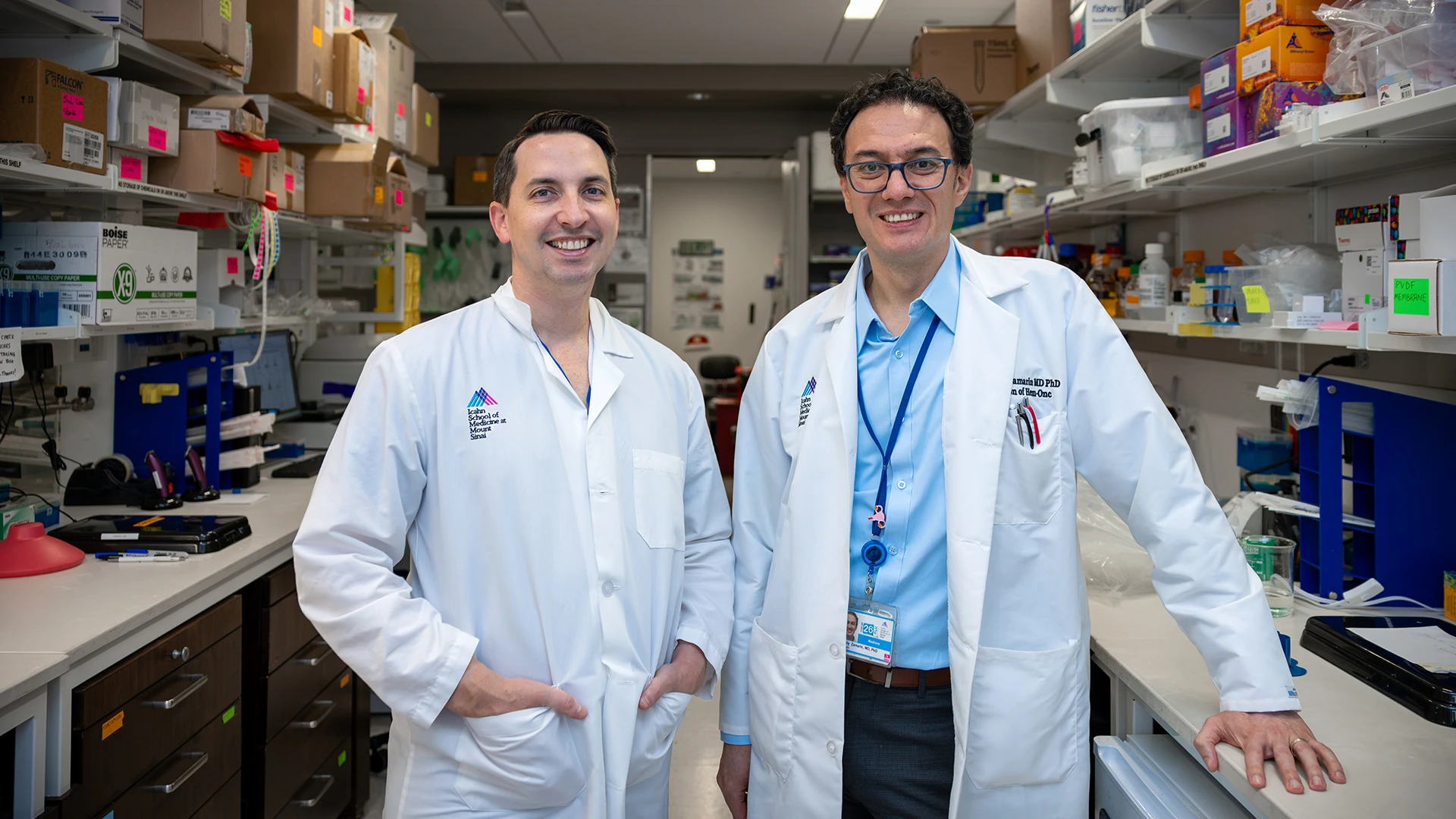
Eric Craig, MD, with Dmitriy Zamarin, MD, PhD
Integrating Data Science Into Immunotherapy Research
Immunotherapy has become a highly effective treatment option for several solid tumors and is now a front-line treatment for endometrial and cervical cancers. "We’re seeing patients with advanced gynecologic cancers—who not long ago would almost certainly have died—achieve deep, durable remissions with immunotherapy-based treatment and maintenance," says Dr. Craig.
Ovarian cancer is a notable outlier. Studies suggest that interactions between those tumors and their microenvironment create strong immunosuppression, demanding a more nuanced treatment strategy. Dr. Craig’s research in the Zamarin Lab centers on the mechanisms underlying immunotherapy response, focusing on why some patients derive greater benefit than others.
“My work explores whether combining different immunotherapy agents can improve response rates and overcome resistance, based on the hypothesis that these agents act synergistically to prime the immune system and enhance antitumor activity,” Dr. Craig explains.
Answering those questions and dissecting why combination therapies succeed or fail depends on analyzing complex gene-expression profiles and other high-dimensional datasets. That work demands both computational expertise and close collaboration across disciplines.
Joining the Zamarin Lab is an excellent fit for Dr. Craig’s goal. Dr. Zamarin is also Professor of Immunology and Immunotherapy and a member of the Icahn Genomics Institute and the Marc and Jennifer Lipschultz Precision Immunology Institute. He has served as a principal investigator and a translational chair for several institutional and cooperative group clinical trials exploring novel immunotherapy combinations in gynecologic cancers and other solid tumors.
“Our laboratory seeks to understand the mechanisms by which gynecologic cancers such as ovarian cancer evade the immune response and to develop novel therapeutic strategies to address these mechanisms,” says Dr. Zamarin. “Our research uses animal tumor models and human samples and employs a number of immunologic and genetic techniques, such as single-cell RNA sequencing, T-cell receptor sequencing, flow cytometry, and multiparameter immunofluorescence. Analysis of data emerging from these studies is not trivial and often requires computational background.
“In the laboratory, Dr. Craig established an organotypic tumor culture platform that allowed him to place newly resected patient tumors directly in culture, evaluate their responses to therapeutics, and then perform analyses to understand how the different treatments impacted the cancer cells and the tumor microenvironment.”
Dr. Craig says that the MDSAI coursework was immediately applicable, enabling him to perform in-depth analyses on human tumor samples that would not have been possible without the training.
"I’m fortunate to work with a mentor at the intersection of basic science, medical informatics, and clinical oncology, which creates a natural environment for translational research," says Dr. Craig.
Learning to Speak a Computational Language
Dr. Craig explains that his motivation for pursuing the degree was rooted in the realities of modern clinical cancer research. “The field is increasingly driven by big data and complex genomics, and it's difficult to engage with that work without some computational literacy,” he says.
Collaborations between data scientists and clinicians are often limited less by technical capability than language and cultural gaps between the two fields. The ability to speak both languages creates a bridge that links the clinical context of a problem to a technically feasible solution.
Dr. Craig says that the graduate program changed how he engages with both research and emerging technologies. “Learning the fundamentals—especially as AI becomes more integrated into medicine—has helped me better understand where these tools are beneficial and how to use them responsibly," he explains.
His project for the MDSAI program uses predictive algorithms to improve classification of variants of uncertain significance, a persistent challenge in clinical genetics. This addresses a clinical gray zone, where patients with concerning family histories lack clear guidance. By improving how these variants are interpreted, his work aims to identify patients who may benefit from risk-reducing surgery and supports more informed clinical decision-making.
"This project addresses a real clinical gap," says Dr. Craig. "I wanted to become comfortable enough with data science to translate a clinical need into a problem that could be addressed using computational methods."
Dr. Craig emphasizes how valuable the graduate program has been and will continue to be to his fellowship training. As he refines his skills as a surgeon and clinician, he looks forward to remaining engaged in research on both sides of the lab.
"It's clear that the most meaningful advances in oncology result from interdisciplinary collaborations," he says. "I’m excited to use my clinical and computational training to help make those partnerships more effective."