Understanding these processes will enable clinicians to determine when and how to intervene to preserve brain health and cognitive capacity across the entire lifespan.
Mount Sinai has become a leader in transforming our understanding of the aging brain. Our investigators at The Friedman Brain Institute (FBI) are decoding the molecular and cellular mechanisms that determine why some brains remain sharp and adaptable well into old age while others fare less well and succumb to age-related neurodegenerative disorders. Their wide-ranging work, spanning molecules and genes to brain-wide circuits and human cognition, is built on a powerful idea: that maintaining brain health into advanced age is within reach.
This issue of the FBI newsletter focuses on how aging and disease intersect, and how new discoveries are illuminating strategies to sustain cognitive vitality throughout life.
Trey Hedden, PhD, and colleagues in the Alzheimer’s Disease Research Center describe how imaging techniques and fluid biomarkers are transforming early detection of Alzheimer’s disease (AD). Using advanced brain imaging methods, Dr. Hedden’s team is uncovering how molecular, vascular, and neurochemical changes, ranging from amyloid and tau accumulation to dopaminergic signaling and genetic risk, converge over time to shape cognitive aging. This information can help to guide preventive interventions before age- and disease-related memory loss ever begins.
Alison M. Goate, DPhil, a pioneer in the genetics of AD, traces how the discovery of variation in our genetic makeup can increase the risk of developing AD and other age-related dementias. Her work identifies microglial and lipid-processing pathways that open entirely new avenues for developing AD medications, including gene-based and precision-medicine approaches aimed at reducing, or even reversing, inherited disease vulnerabilities.
Moving from risk to resilience, Joseph Castellano, PhD, and his laboratory explore how youth-associated blood factors, including the protein TIMP2, can restore memory and neuroplasticity in aged animals. These discoveries reveal factors that link a healthy body to a healthy brain, which may ultimately yield new approaches to rejuvenating the aging brain.
Fanny Elahi, MD, PhD, extends this work to the human level, uncovering blood-based vascular proteomic signatures that predict rapid brain decline during aging. Her research demonstrates that sex differences, vascular function, and the health of peripheral organs all intertwine to influence cognition. Dr. Elahi’s work promises to reveal blood-based biomarkers that can be used not only for early detection, but also to monitor how the brain responds to interventions targeting the biology of aging itself.
Anne Schaefer, MD, PhD, provides a cellular perspective on brain aging, showing how the brain’s resident immune cells, microglia, shift from protective to inflammatory states during aging and disease. Her team’s recent discoveries highlight microglial adenosine signaling as a central regulator of neuronal activity, sleep, and memory as they pioneer strategies to rejuvenate these cells through epigenetic and pharmacological approaches.
Together, our work shows that brain aging is not an inexorable decline, but a process that can be measured, understood, and ultimately modified. At Mount Sinai, we are advancing the science of brain aging that will ultimately make this possible, bridging molecular discovery, clinical research, and therapeutic innovation to promote lifelong brain health.
Featured
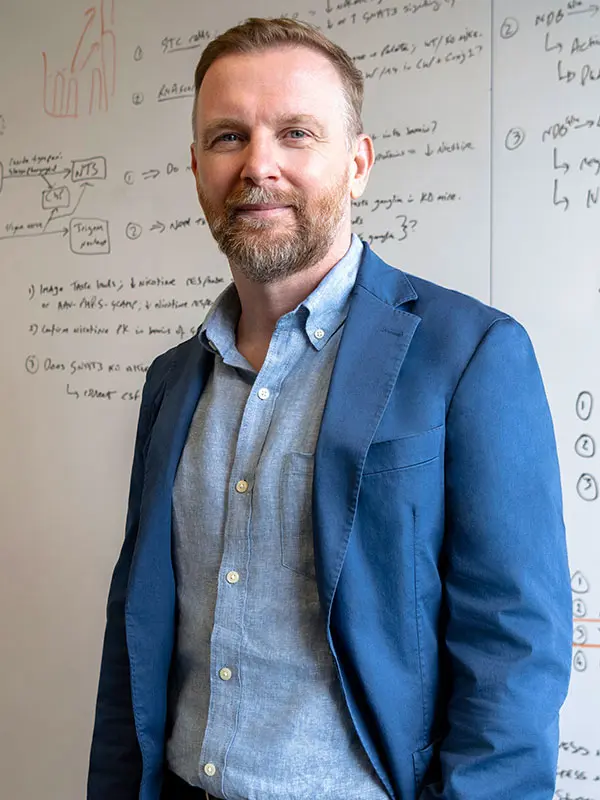
Paul J. Kenny, PhD
Ward-Coleman Professor and Chair, Nash Family Department of Neuroscience; Director, The Friedman Brain Institute, and Director, Drug Discovery Institute, Icahn School of Medicine at Mount Sinai @PaulKennyPhD