Hypophonia—reduced vocal loudness—is one of the most common communication impairments in people with Parkinson’s disease. It is also one of the most functionally limiting, says Ümit Daşdöğen, PhD, CCC-SLP.
“People with Parkinson’s disease often perceive their speech to be at a normal loudness, even when it is significantly softer than they realize,” says Dr. Daşdöğen, Research Director, Speech and Language Pathology, The Grabscheid Voice and Swallowing Center of Mount Sinai, and Assistant Professor, Otolaryngology, Icahn School of Medicine at Mount Sinai. “This can make interactions with others very frustrating, for both the speaker and the listener, and can contribute to withdrawal, reduced participation, and increased risk for depression and isolation.”
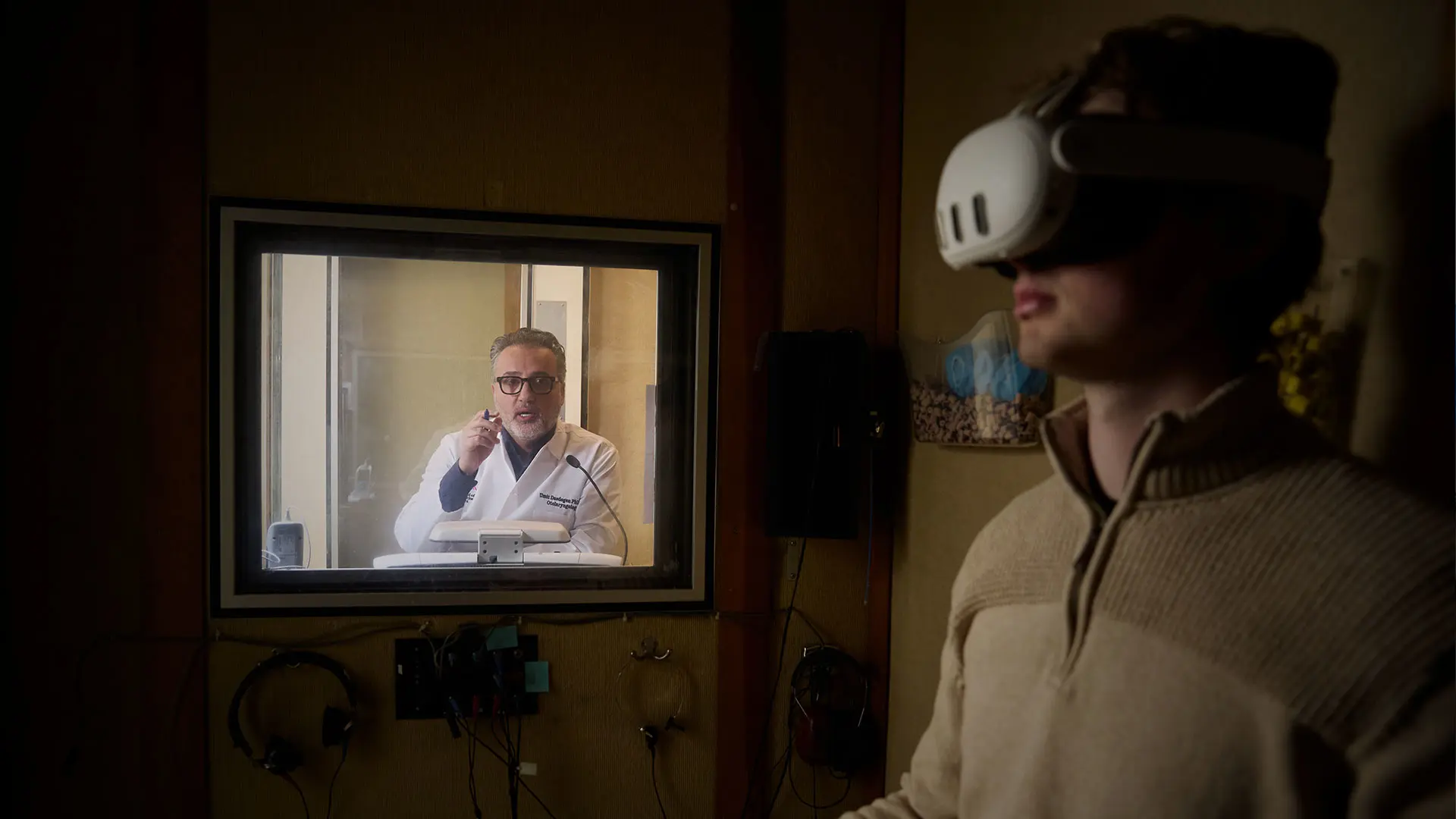
Dr. Daşdöğen is developing a new tool, Immersive VoiceSpace®, to enhance communication skills. The tool uses virtual reality (VR) to help people with Parkinson’s disease and other voice disorders improve their ability to communicate by engaging in realistic, task-based scenarios in clinical settings and at home.
There are well-established, evidence-based approaches for improving communication in people with Parkinson’s disease. Those techniques are highly successful and can produce meaningful changes in vocal loudness and communicative effectiveness. However, they are also intensive—often requiring multiple in-person therapy sessions each week—and rely on structured cueing strategies that do not always mirror the rapidly changing conditions of daily communication.
“One of the biggest problems with therapy is generalization. Patients learn something in the clinic. But when they go out, they cannot maintain what they’ve learned because they aren’t using it under the same conditions with the same types of feedback,” Dr. Daşdöğen says. “This VR platform is not intended to replace established, evidence-based treatments. Instead, it extends those treatments by improving generalization and transfer of what patients learn in therapy into situations where they actually communicate.”
A Tool to Extend Evidence-Based Speech Therapy
In a typical scenario using the Immersive VoiceSpace platform, a patient might be seated in a virtual restaurant, for example. The patient must adjust their volume as they converse with a dining companion seated beside them and speak loudly to get the attention of a server. If they hit the target threshold for sound pressure set by the therapist, the server approaches the table and listens as the patient places an order. If their sound pressure falls below that target, the server turns his back and walks away. “This is a very functional, real-world task,” Dr. Daşdöğen says.
In pilot studies conducted with both individuals without communication impairments and patients with voice disorders, Dr. Daşdöğen and colleagues demonstrated that participants systematically adapted their vocal behavior to the communicative demands of the virtual environment. Those studies showed that participants use the system as expected, raising and lowering their vocal loudness and pitch appropriately. The research also demonstrated that visuospatial cues, such as room size and listener distance, significantly affect how people perceive and produce their voice. “That kind of feedback is hard to replicate in a clinical setting,” he says. “Virtual reality allows people to practice using real-world cues.”
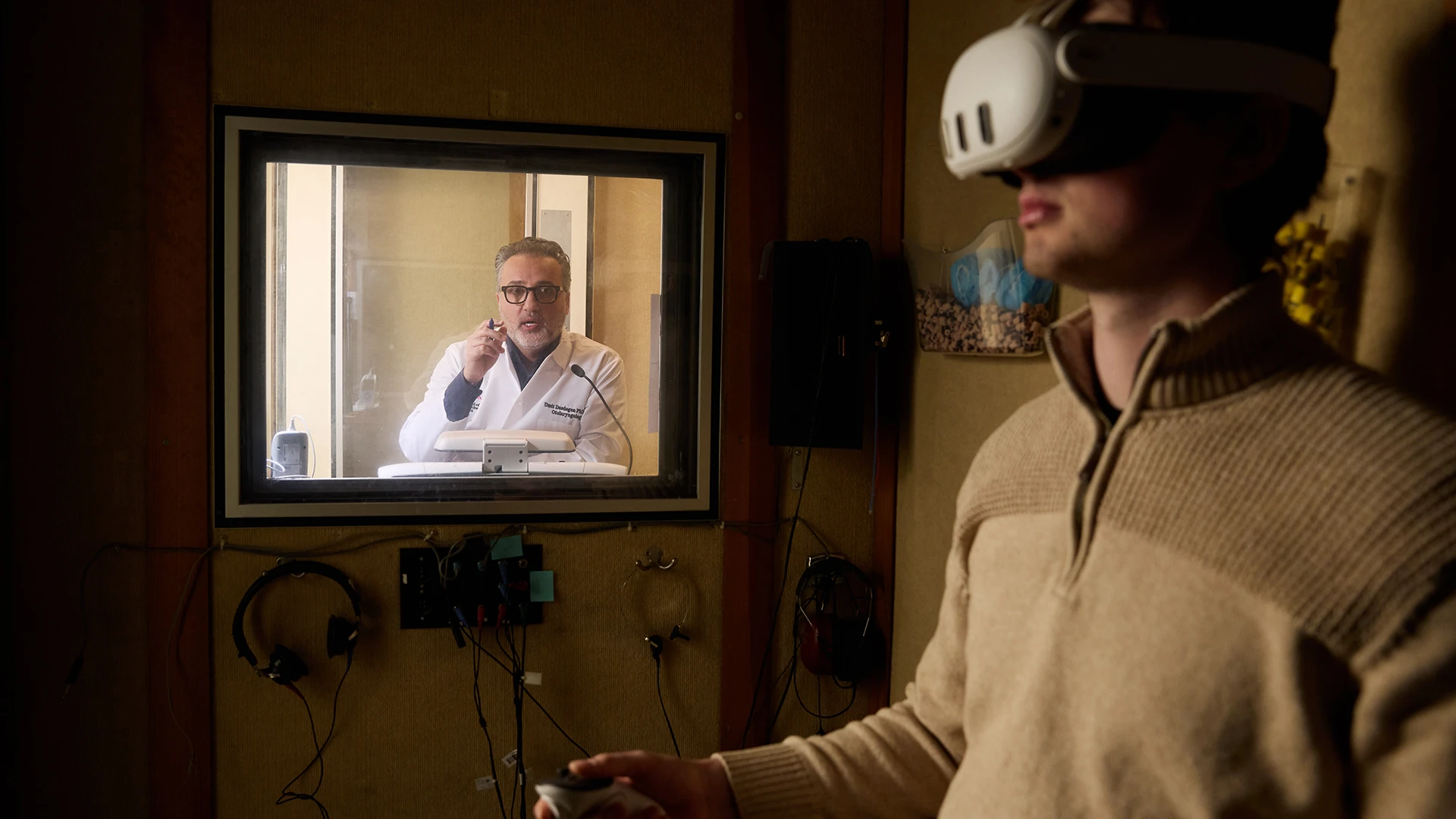
A patient using the Immersive VoiceSpace tool. Dr. Daşdöğen observes from the window.
Now, Dr. Daşdöğen is testing the system in patients with voice disorders, including Parkinson’s patients with hypophonia. Though research is ongoing, early pilot work suggests that patients undergoing evidence-based treatment for hypophonia adjust their vocal intensity appropriately when speaking in virtual settings, even without prompts from their clinicians.
He envisions providers using the platform to complement in-person speech therapy. Therapists could help patients practice in a variety of virtual settings, such as speaking to caregivers in a hospital, giving a presentation in a meeting room, or ordering a meal at a restaurant. The tool could also be used for practice sessions at home, potentially reducing the frequency with which patients must travel for in-person therapy.
As patients practice, they receive immediate feedback from the avatars’ behaviors, which reflect whether the communicative goal was met. The data from practice sessions can also be shared with their providers via an app, so clinicians can better tailor in-person sessions to work on specific challenges. Providers can also set the difficulty level of the task to support their patients’ progress, Dr. Daşdöğen says.
Virtual Reality for a Range of Speech Disorders
While Dr. Daşdöğen continues to test his platform in patients with hypophonia, he is also honing the prototype. He hopes to add more facial and body gestures to the avatars’ responses to provide a richer variety of natural feedback to patients as they try to communicate. He also envisions a next-generation platform that incorporates AI-assisted language models to make conversations with virtual avatars more varied and engaging. As VR hardware continues to evolve, the system is likely to become increasingly lightweight and accessible, he adds.
Even in its current form, using existing VR headsets, the system is proving to be feasible. In the pilot studies, users have expressed enjoyment. “It’s fun for them—more like a game than therapy,” Dr. Daşdöğen says.
In other clinical uses of VR, such as physical rehabilitation, research has shown that such enjoyment translates to greater motivation and compliance with therapeutic protocols. “I’m hopeful this system will also motivate and inspire patients with voice disorders to practice speaking techniques outside the clinic,” he says.
The platform is not limited to patients with Parkinson’s-related communication impairments. For example, older adults with vocal fold atrophy can also have trouble speaking at adequate volumes and may benefit from practice sessions that mimic real-world scenarios. And sound pressure is only one possible target. The virtual tasks could also be tailored to address additional therapeutic targets. Dr. Daşdöğen is developing modules aimed at modulating speaking pitch for vocal feminization in individuals receiving gender-affirming voice care, for example.
“In the future, I anticipate virtual reality will be used not only for various voice disorders, but as a versatile tool across a wide range of communication challenges,” Dr. Daşdöğen says.
Featured

Ümit Daşdöğen, PhD, CCC-SLP
Research Director, Speech and Language Pathology, The Grabscheid Voice and Swallowing Center of Mount Sinai; Assistant Professor, Otolaryngology, Icahn School of Medicine at Mount Sinai