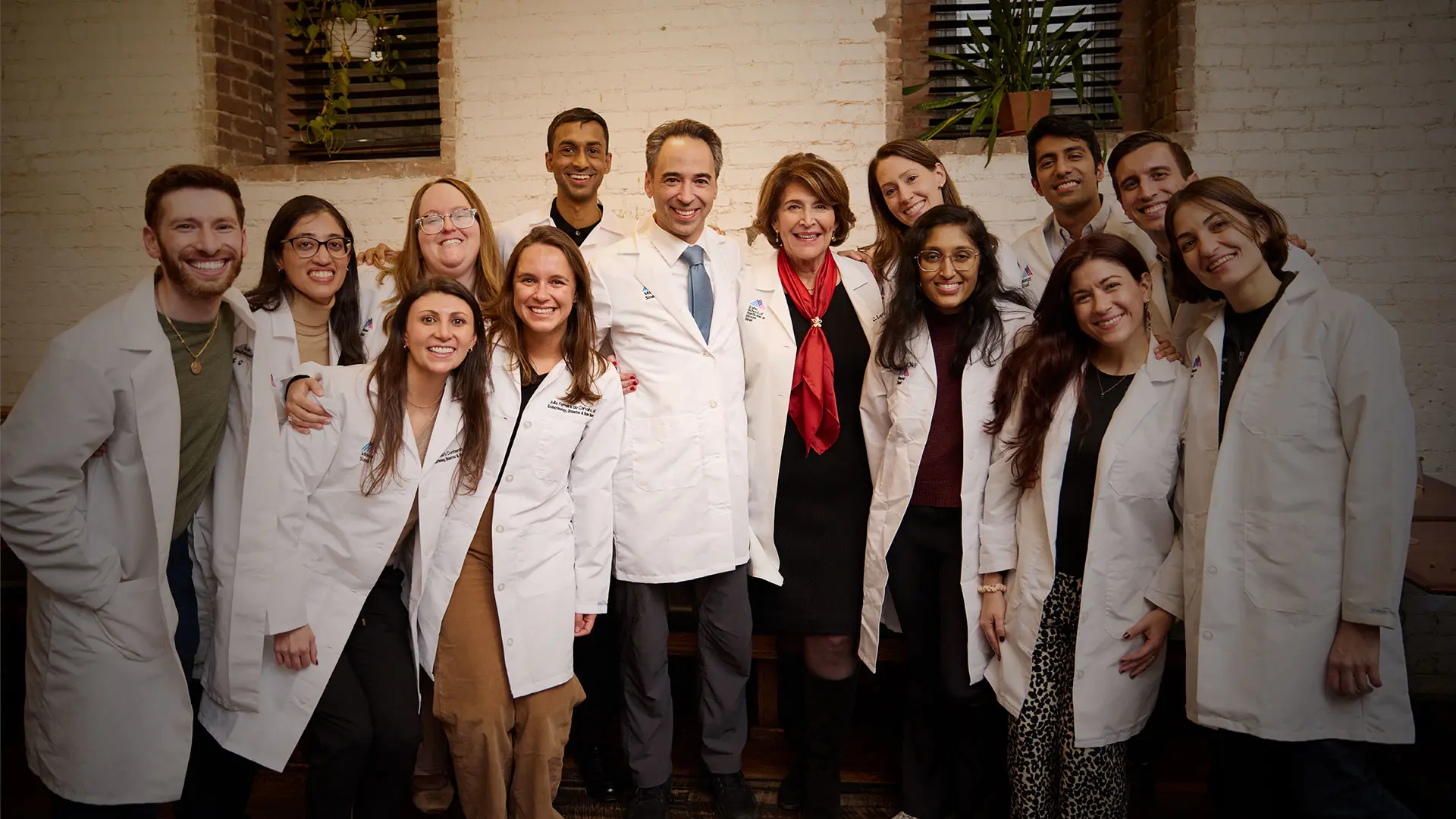
The merger of Mount Sinai’s Endocrinology fellowships into a systemwide, five-hospital program has created the largest such program in the United States, with the 14 fellows gaining a wide variety of experience in research and clinical care. In the Endocrinology, Diabetes and Bone Disease Fellowship, fellows are treating complex conditions in the large population that the Mount Sinai Health System serves, and working closely with renowned experts in the field. By 2025, many of the fellows joined the faculty of the Icahn School of Medicine at Mount Sinai.
Previously, there were two separate endocrinology fellowships, one housed at Mount Sinai Beth Israel, Mount Sinai Morningside, and Mount Sinai West, and one at The Mount Sinai Hospital and the James J. Peters Veterans Affairs Hospital in the Bronx. Now, there is one broad program with seven fellows per class, who rotate through all five campuses.
“We have the largest program by far in the country since we merged. It has been extremely successful. There is a definite buzz about our fellowship program,” says Alice C. Levine, MD, Director of the fellowship and Professor of Medicine (Endocrinology, Diabetes and Bone Disease), Icahn School of Medicine at Mount Sinai. “Fellows get exposed to many different sites, attendings, and patient populations. It has been a very exciting endeavor.”
Five of the first fellows in the expanded program are now Assistant Professors of Medicine (Endocrinology, Diabetes and Bone Disease) at the Icahn School of Medicine at Mount Sinai—Rachel Sheskier, MD, Jiby Yohannan, MD, and Leah Kaplan, MD, and former chief fellows Daniel Slack, MD, and Alon Mazori, MD. In addition, four members of the class of 2025 have joined Mount Sinai faculty: Suma Gondi, MD, Diana Norwich, MD, Jennifer Abrams, MD, and Jane Hand, MD. Looking forward, two fellows who will be graduating in June 2026 as well as a sixth member of the fellowship class of 2024 are set to join Mount Sinai later in 2026.
The expanded program allows fellows to choose either a two-year master clinician or three-year physician-scientist track. During the first year, all fellows explore the breadth of endocrinology with hospital rotations encompassing diabetes, adrenal/pituitary, thyroid, bone and mineral, reproductive endocrinology, high-risk obstetrics, obesity medicine, and transgender medicine, learning from world-renowned mentors in each area.
Second-year master clinician fellows divide their time between outpatient clinical work in subspecialty endocrine clinics and scholarly projects in a focused area under the direction of faculty mentors who are, themselves, master clinicians. The physician-scientist fellows spend 75 percent of their second and third years on mentored research, with dedicated funding, and with a view toward developing careers as physician-scientists.
The fellowship program takes advantage of all the strengths of the Mount Sinai Health System, says Co-Director Michael A. Via, MD, Professor of Medicine (Endocrinology, Diabetes and Bone Disease), and Medical Education. “Dr. Levine and I took a lot of feedback from fellows themselves and how they thought things might go,” he says. “With that, we put together a schedule and a curriculum and a series of rotations. The system we have in place provides world-leading fellowship training in endocrinology.”
The fellows have the opportunity to work closely with mentors who are world leaders in their fields. The two chief fellows, Deborah Schwartz, MD, and Nicholas Musacchio, MD, say they have honored to work with Dr. Levine. Dr. Schwartz’s primary project is focused on investigating luteinizing hormone/ human chorionic gonadotropin (LH/hCG) [VG1] receptors in adrenalectomy samples from post-menopausal women.
“Through this translational research project, I have gained insight into the intersection of adrenal disease, women's health, and aging,” Dr. Schwartz says. “Learning from Dr. Levine's immense clinical and research expertise has allowed me to develop a profound understanding of the adrenal conditions that affect my patients."
Dr. Musacchio says, “I’ve become involved in several exciting projects that have enhanced my education as a fellow, including a project investigating LH/hCG receptor expression in aldosterone producing micronodules. I’ve also had the opportunity to present our research on adrenocortical carcinoma at a national conference and attend the Endocrine Fellows Foundation’s Adrenal Preceptorship."
Other fellows are immersed in a range of subjects:
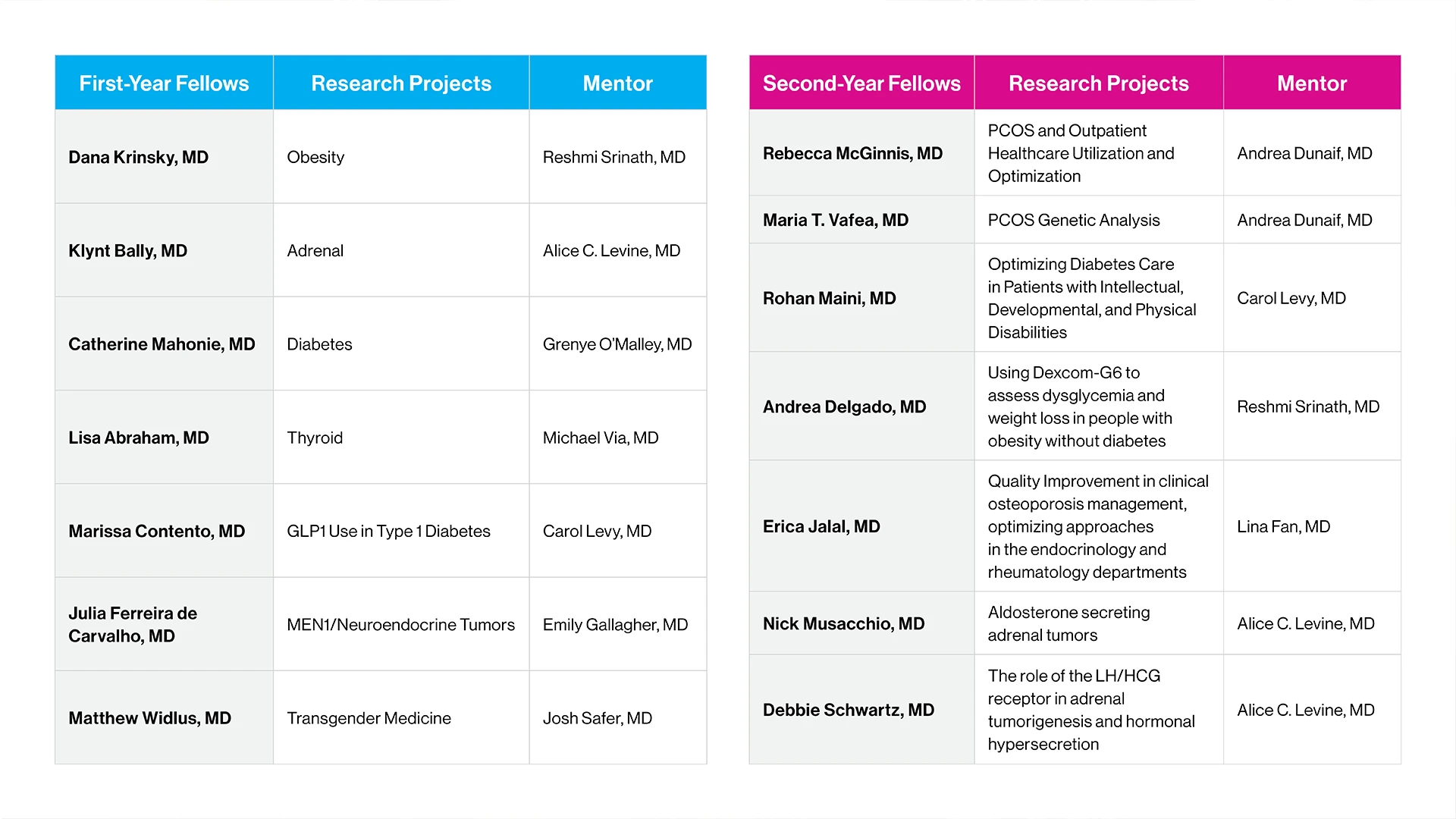
Among the current fellows, 13 opted to join the two-year master clinician track, and one has enrolled in the three-year physician scientist track. A strength of the program is that it offers this variety of options, Dr. Via says. "It is a rare person who dedicates themselves to a career in scientific investigation and research. For fellows drawn to this path, the physician scientist track can launch a career in medical science. We also train many fellows within the master clinician track, where most of the time is spent in the care of patients,” Dr. Via says. “At Mount Sinai, we are proud to train fellows for both of these paths. Our graduates go on to become future leaders in academic medicine."
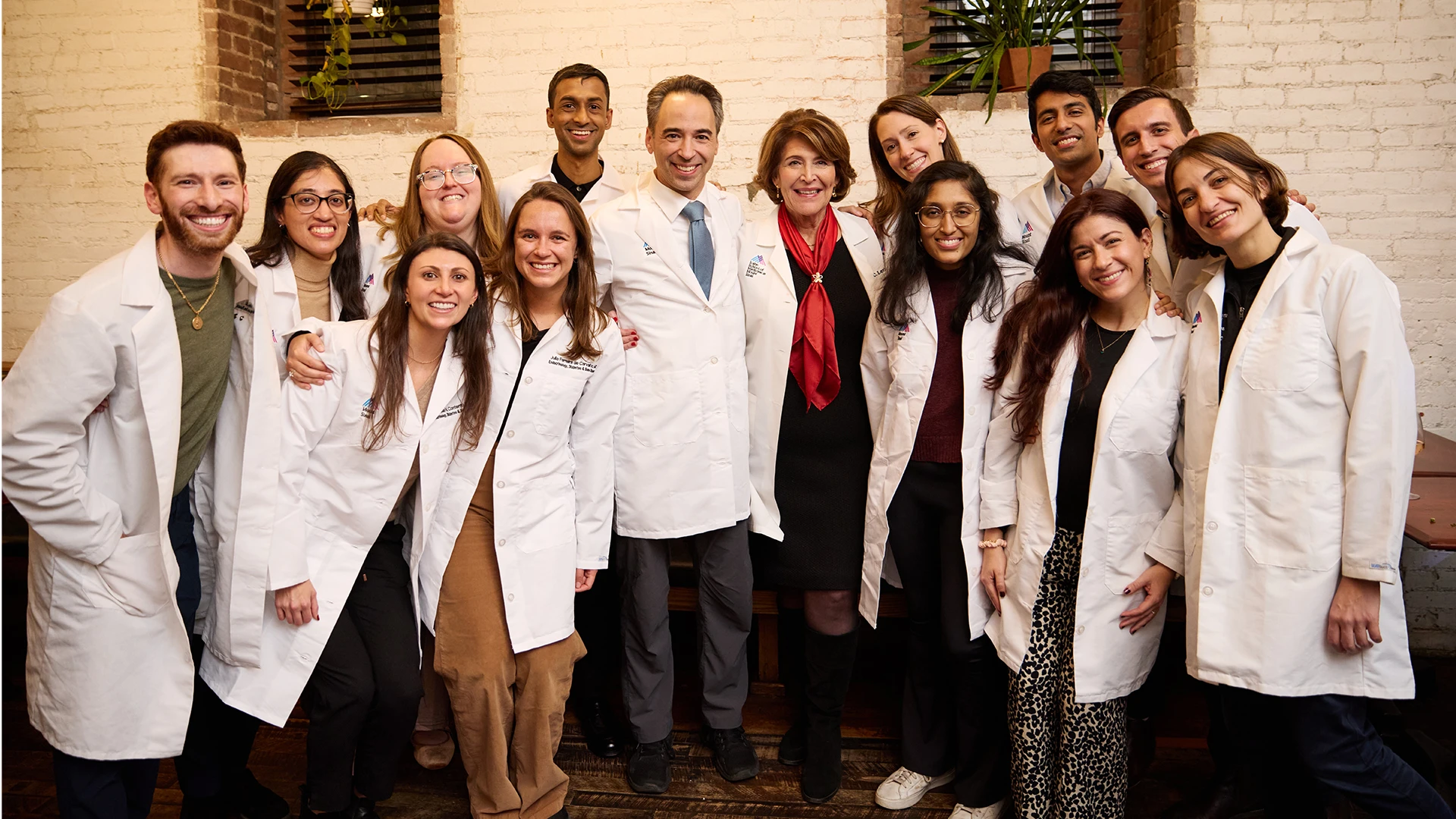
The fellows and co-directors, from left: Matthew Widlus, MD; Lisa A. Abraham, MD; Marissa Contento, MD; Dana Krinsky, MD; Julia Ferreira de Carvalho, MD; Klynt Bally, MD; Michael A. Via, MD; Alice C. Levine, MD; Rebecca Lawrence McGinnis, MD; Erica Jalal, MD; Rohan Maini, MD; Andrea Delgado Nieves, MD; Nicholas Musacchio, MD; and Maria Tsikala Vafea, MD.