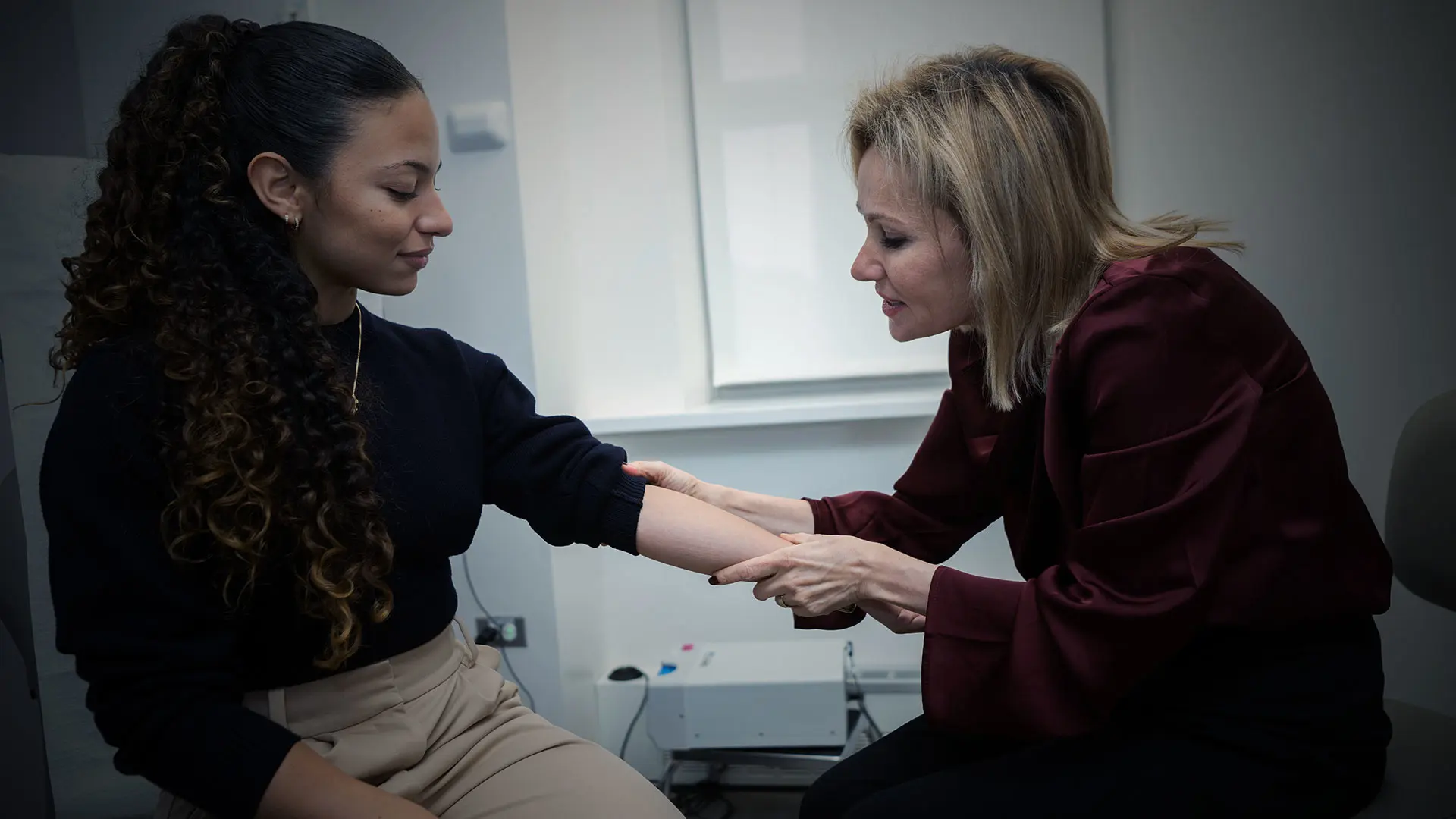
In June of 2025, Mount Sinai’s Center of Excellence in Eczema received a $5 million grant from Clifford S. Asness, PhD, and Laurel Asness to advance research and clinical care for eczema and related allergic conditions. The donation will be transformative, and not just because of the Center’s new name: The Asness Family Center of Excellence in Eczema and Allergic Conditions at Mount Sinai.
The Center, directed by Emma Guttman-Yassky, MD, PhD, Waldman Professor and System Chair of the Kimberly and Eric J. Waldman Department of Dermatology, will now have the resources to broaden its exploration of atopic dermatitis (or eczema), a pervasive skin condition that affects up to 20 percent of children and up to 10 percent of adults around the world.
“With this grant, we plan to look at commonalities between eczema and asthma—which affects 8.6 percent of children and adults in the United States—as well as hay fever, conjunctivitis, and food allergies,” says Dr. Guttman. The goal? Using state-of the-art research in the laboratory combined with clinical research and clinical trials, Dr. Guttman and her team are designing studies to discover which drugs might effectively target not just one allergic condition but several. “We want to understand which treatments are most effective for all of them, as well as which are uniquely effective for eczema,” she explains.
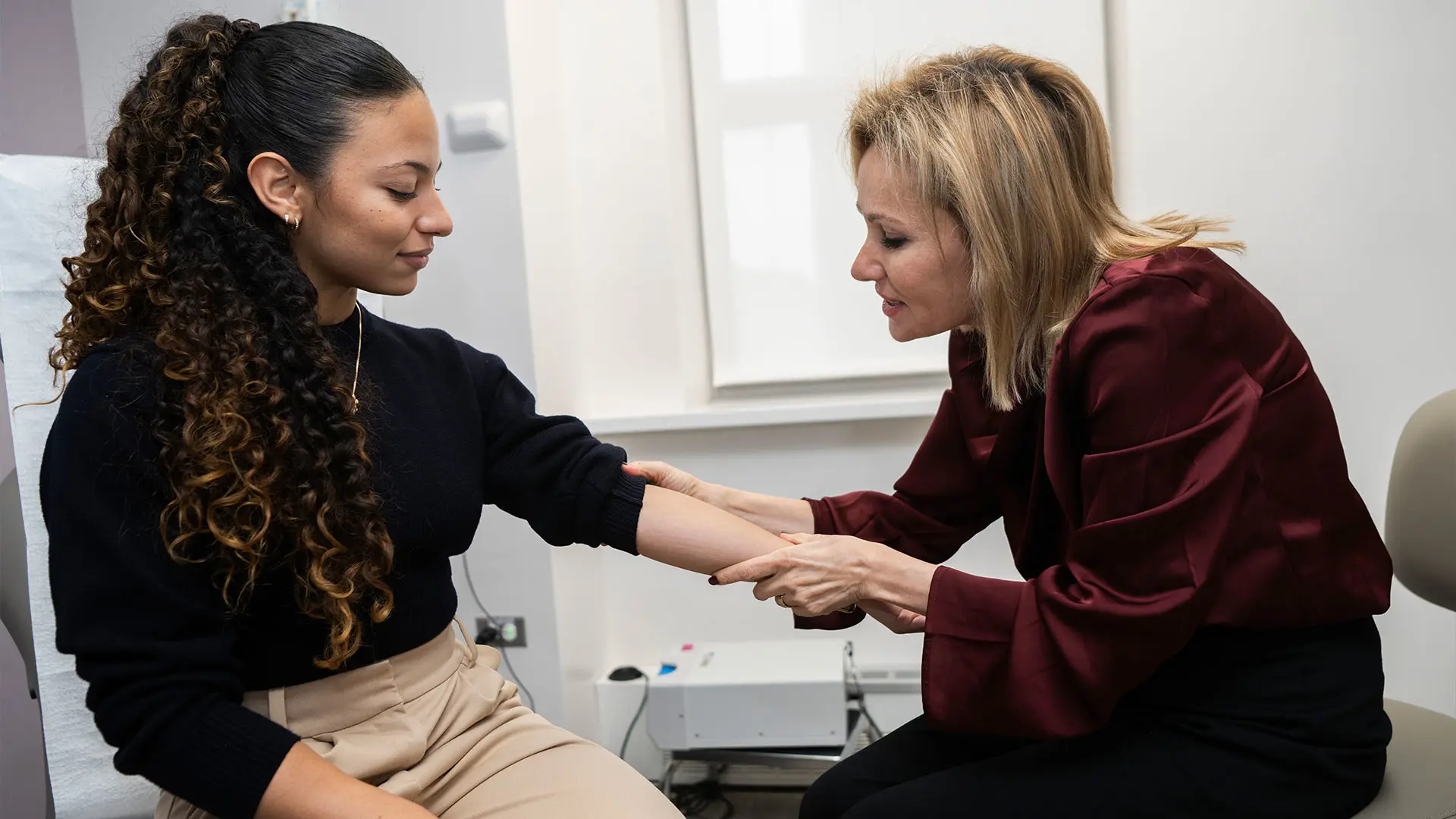
Emma Guttman, MD, PhD, leads the team at the Asness Family Center of Excellence in Eczema and Allergic Conditions.
Using tape strips to uncover causes beneath the skin
Dr. Guttman and her team are using a novel, minimally invasive, and painless technique that involves applying sticky strips of tape to gently lift off skin cells from patients, along with more traditional sample collection through blood work and, occasionally, skin biopsies. “Since so many children have eczema, it’s important to us that any studies done on patients are as minimally invasive as possible,” she says.
Through the information gleaned from these samples, Dr. Guttman and her team are seeking to identify inflammatory immune molecules unique to eczema, as well as molecules that patients with eczema and asthma have in common. Another aim is to try to include a huge age range in these trials to understand how these conditions differ and overlap on a molecular level from the youngest patients to the oldest. “What’s going on at the molecular level has a huge relevance to what treatments will work best,” says Dr. Guttman.
Surprising similarities
One fascinating finding has already emerged: Preliminary skin data from children, adolescents, and adults with asthma suggest that even when these patients don’t have skin diseases like eczema, their skin cell samples show barrier abnormalities of the kind that also appear in people with atopic dermatitis.
“Our tape strips are providing clues to common biomarkers and immune abnormalities in both skin and lung disease,” says Dr. Guttman. “What many people don’t realize,” she says, “is that when you have eczema, you also have a high risk of asthma and other allergies.” But while there are biologic treatments that are effective for atopic dermatitis, asthma, and other allergic conditions, there are no treatments that prevent them. “If we can identify the biomarkers that lead to these associated conditions early on, like eczema and asthma, we can treat one or the other early and prevent the associated conditions from developing in patients later in life.”