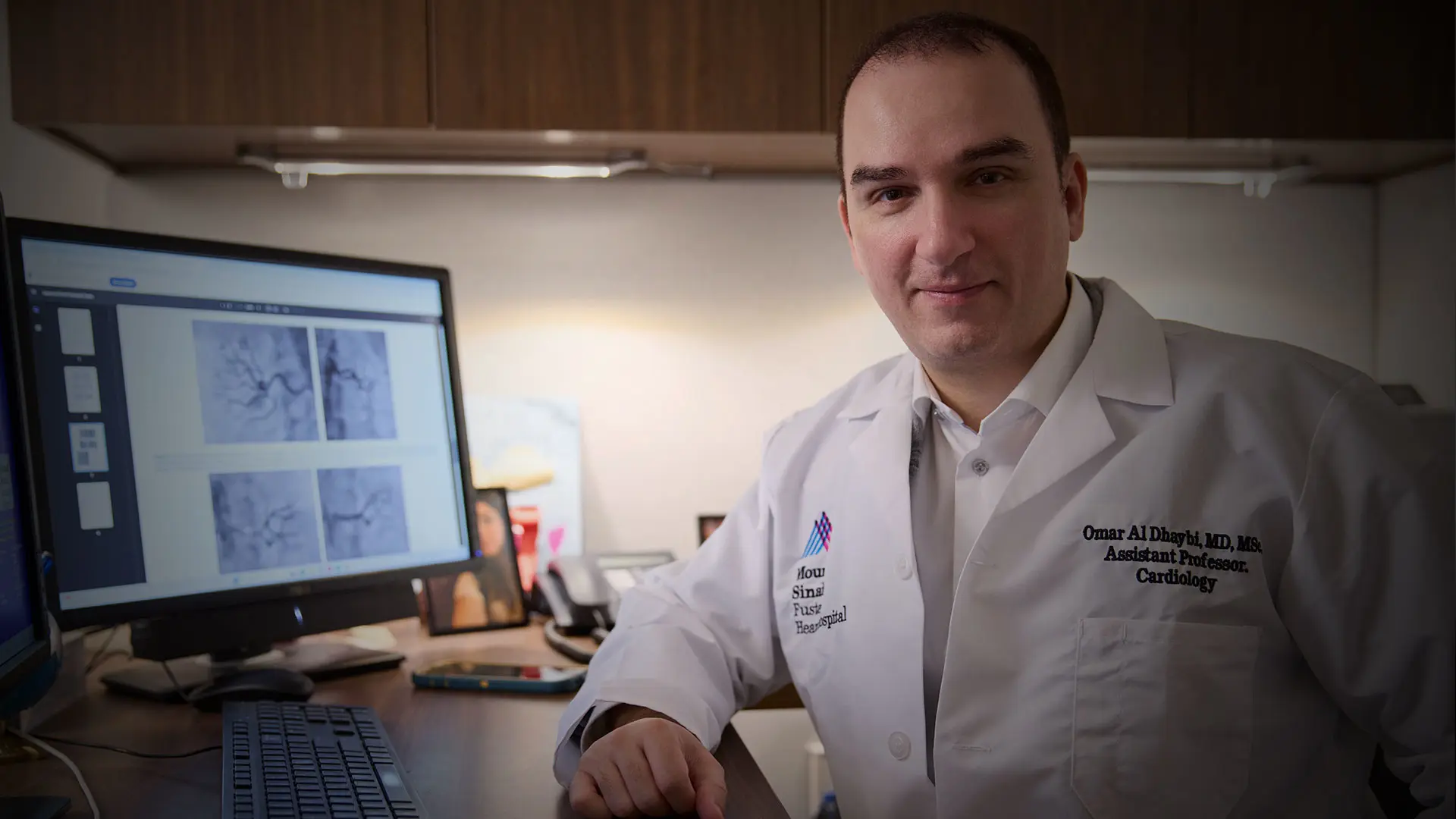
The Mount Sinai Fuster Heart Hospital program led by Omar Al Dhaybi, MD, MSc, FASN, in July 2025 received Comprehensive Hypertension Center Certification from the American Heart Association (AHA). The designation recognizes Mount Sinai Fuster Heart Hospital’s status as a leading referral center for diagnosing and treating the most complex cases of primary and secondary hypertension.
The AHA Comprehensive Hypertension Center at The Mount Sinai Hospital has assembled the resources and expertise to manage challenging forms of elevated blood pressure—those with no easily identifiable cause and those that stem from medical conditions such as chronic kidney disease, dysautonomia, and postural orthostatic tachycardia syndrome.
“Hypertension is a fascinating and complex disease, with each patient exhibiting a different phenotype,” says Dr. Dhaybi, Assistant Professor of Medicine (Cardiology) at the Icahn School of Medicine at Mount Sinai. Dr. Dhaybi, a nephrologist with extensive training and expertise in diagnosing and treating hypertension, joined Mount Sinai in late 2024.
The Comprehensive Hypertension Center, one of only a few nationwide, is expanding such leading-edge services as 24-hour ambulatory blood pressure monitoring, adrenal vein sampling (AVS), and renal denervation. It also gives patients access to clinical trials around novel therapies, such as injectable medications, use of implantable pacemakers, and a new class of inhibitors that block the excess production of aldosterone from the adrenal glands that can trigger high blood pressure.
“Our mission is to identify the real drivers of the disease, which almost always involves a multitude of factors,” Dr. Dhaybi says. “In fact, many of the patients I see in the clinic present with what I call ‘pseudo-hypertension,’ meaning if you dig a little deeper into what seems like resistant hypertension, you may find that the patient is not taking their medications, for example, or that sleep deprivation is a normal and debilitating part of their lifestyle.”
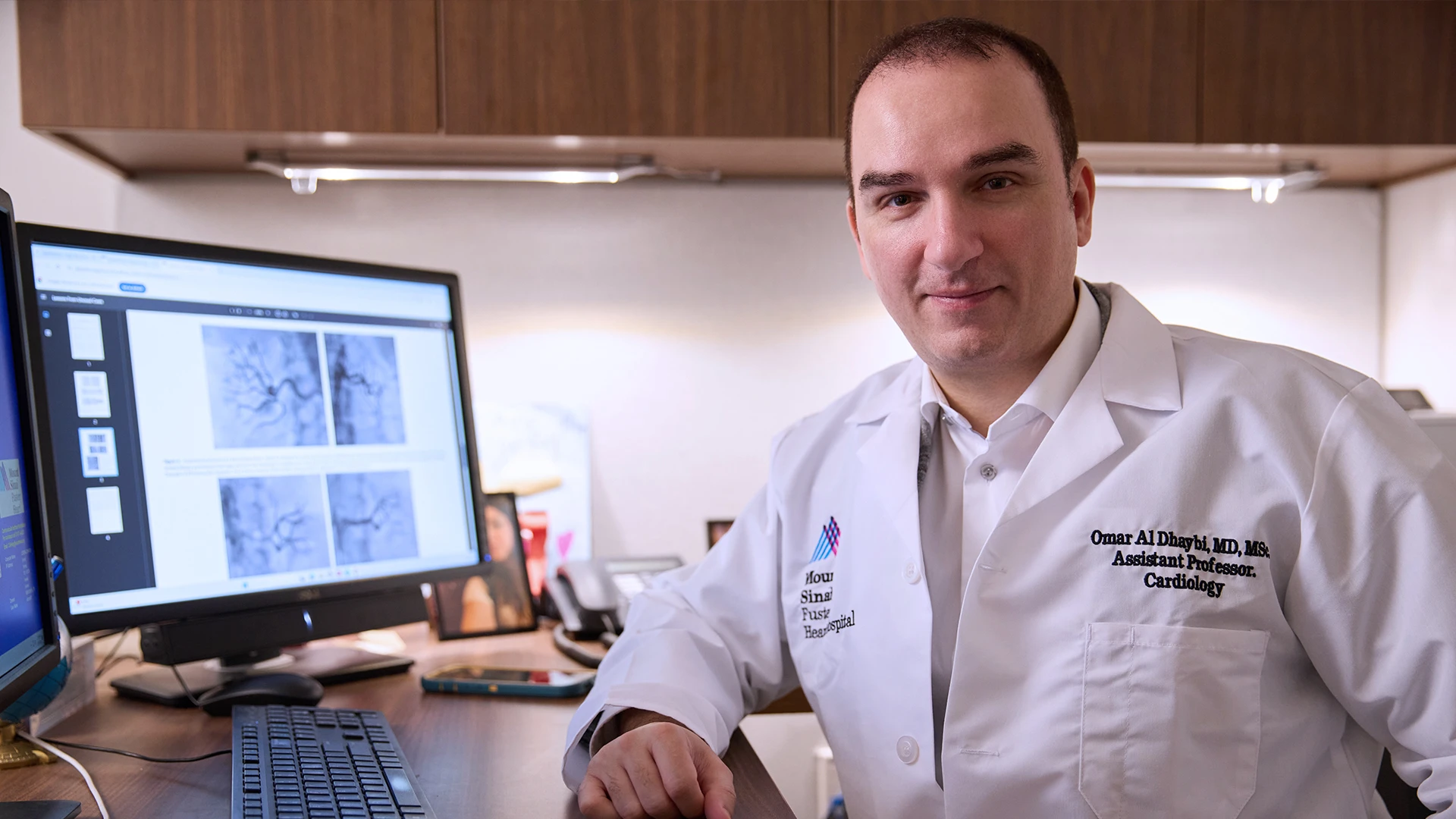
Omar Al Dhaybi, MD, MSc, FASN, Director of the Center.
“Our mission is to identify the real drivers of the disease, which almost always involves a multitude of factors.”
-Omar Al Dhaybi, MD, MSc, FASN
For physicians confronting treatment-resistant cases, Dr. Dhaybi says, “the key message is we have many good tools to diagnose, treat, and manage uncontrolled hypertension, but they must be part of a methodical, stepwise approach that always starts with the basics.”
Among the most effective and accurate diagnostic tools in the hands of the Center’s specialists is round-the-clock blood pressure monitoring. Since arriving at Mount Sinai, Dr. Dhaybi has been expanding the service and plans to transition from use of the traditional monitor with blood pressure cuff, which patients pick up and take home with them, to wearable patches that provide continuous, day-and-night surveillance through ultrasound. Specialists at Mount Sinai consider this technology, which is extraordinarily convenient for patients, to be a promising tool in the treatment of hypertension.
Mount Sinai Fuster Heart Hospital is an early adopter and has long been a leader in renal denervation, which was approved in late 2023 by the U.S. Food and Drug Administration as an adjunct treatment for patients with severe hypertension who are unresponsive to other therapies. The minimally invasive procedure uses catheters to send ultrasound or radio frequency energy to the renal arteries, disrupting sympathetic nerves whose overactivity is associated with chronic hypertension. Research is now exploring if denervating the hepatic artery on top of the sympathetic artery can yield even greater benefits in lowering blood pressure.
“The challenge with renal denervation is it’s not intended for everyone, which requires figuring out who the most suitable patients are, based largely on the condition of their blood vessels,” Dr. Dhaybi says. Backed by its expertise, state-of-the-art imaging systems, and support from Mount Sinai’s experienced endovascular interventional cardiology and vascular medicine teams, the Center excels in providing expert clinical evaluation for patient selection prior to surgery, often on a referral basis for physicians outside the institution.
The Center also excels in treatment of primary aldosteronism—a complex condition associated with high blood pressure—that may require adrenal vein sampling in advance of surgical intervention. This minimally invasive procedure, performed by highly trained endocrine surgeons at Mount Sinai, involves cannulating the adrenal veins to probe the blood for excess production of the hormone aldosterone, as well as for cortisone. Adrenal vein sampling as a workup for primary aldosteronism, along with companion confirmation testing, is available at only a handful of hospitals nationally, the Comprehensive Hypertension Center being one of them.
In addition to its work in the clinic, the Center is investigating new therapeutic pathways for hypertension, which afflicts 47 million American adults. Dr. Dhaybi and his team are involved in clinical studies of injectable treatments, which he says could improve medication adherence and provide much longer blood pressure control than current regimens achieve. The Center is also investigating lowering blood pressure through use of an implanted pacemaker that delivers atrioventricular interval modulation therapy. Other active avenues of research for the Center involve understanding the role of corticosteroids in hypertension, and how genetic variants may factor in the pathophysiology of hypertension.
“The treatment and management of high blood pressure promise to improve dramatically over the next 5 to 10 years,” Dr. Dhaybi says, “and we’re working hard to ensure that our Comprehensive Center is part of the vast body of work, nationally and globally, that is driving that transformation.”