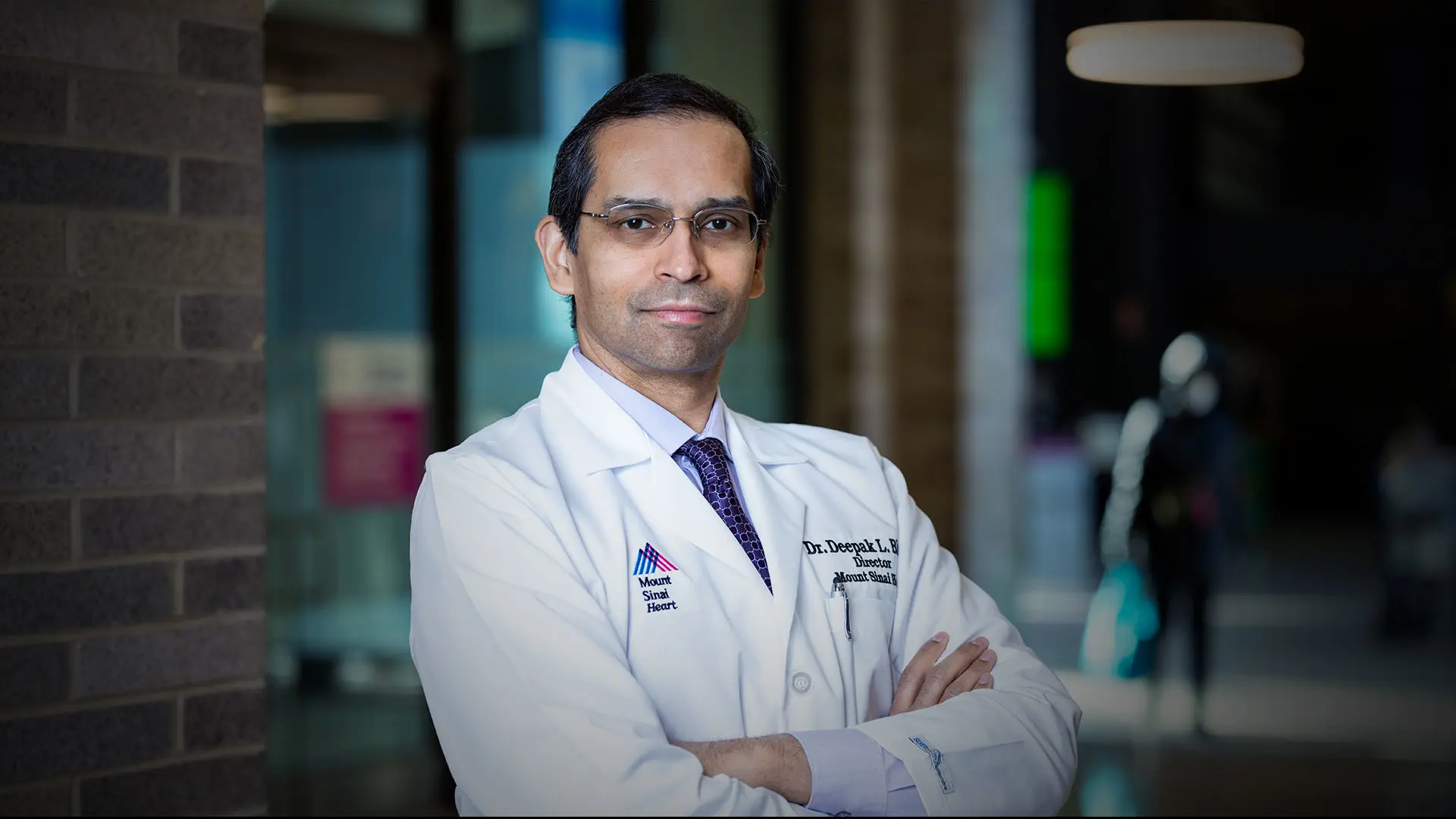
Message From the Director
Mount Sinai Fuster Heart Hospital at The Mount Sinai Hospital is ranked No. 2 nationally for Cardiology, Heart and Vascular Surgery, and Fuster Heart Hospital at Mount Sinai Morningside and Mount Sinai West is ranked No. 17 nationally by U.S. News & World Report for 2025-26. Fuster Heart Hospital at The Mount Sinai Hospital is ranked No. 1 in New York and No. 6 globally by Newsweek’s “World’s Best Specialized Hospitals” in 2026 for both Cardiology and Cardiac Surgery.
I am proud to share some of the year’s highlights:
The Mount Sinai Health System announced the establishment of the Adams Valve Institute, a new global center dedicated to advancing comprehensive valve disease care and reconstructive valve surgery. It is led by world figures in valve surgery, David H. Adams, MD, and Ismail El-Hamamsy, MD.
With intricate coordination of medical and surgical teams, Mount Sinai performed three triple transplants in 2025—taking the lead in this complex and evolving area of medicine. The teams were led by Anelechi Anyanwu, MD, and Sander Florman, MD.
The American College of Cardiology named Roxana Mehran, MD, FACC, its president. Dr. Mehran, a highly cited investigator and interventionalist, will begin her term in April 2026, following seven years on the ACC’s Board of Trustees and serving as its vice president in 2025.
Several of our studies investigated and advanced cardiovascular treatment: In a study led by Valentin Fuster, MD, PhD, beta blockers were found to provide no clinical benefit for patients who have had an uncomplicated myocardial infarction with preserved heart function, a finding that could overturn a standard treatment paradigm.
The international SCORED trial, in which I was study chair and principal investigator, found that sotagliflozin, a drug approved to treat type 2 diabetes and kidney disease with additional cardiovascular risk factors, can significantly reduce heart attack and stroke among these patients.
And current risk- and symptom-based screening tools used to prevent heart attacks fail to identify nearly half of the people who are at risk of having one, according to a retrospective study led by Amir Ahmadi, MD, and Anna Mueller, MD, an internal medicine resident at the Icahn School of Medicine at Mount Sinai.
Our teams made significant progress in both fundamental and translational research. A breakthrough study led by Hina Chaudhry, MD, found that the gene Cyclin A2, which turns off after birth in humans, can make new, functioning heart cells and help the heart repair itself from injury, including a heart attack or heart failure, when the gene is turned back on.
And the Cardiovascular Research Institute, led by Filip K. Swirski, advanced the understanding of the heart and blood in a broad physiological context, making insights into heart regeneration and the role of immune and metabolic processes in heart health.
Researchers led by Vivek K. Reddy, MD, and Joshua Lampert, MD, calibrated an artificial intelligence algorithm to more specifically identify patients with hypertrophic cardiomyopathy and flag them as high risk for greater attention. And in a further study, the team developed an AI model to make individualized treatment recommendations for atrial fibrillation patients.
In a special supplement—developed by the Icahn School of Medicine in collaboration with Science—leaders at Mount Sinai Fuster Heart Hospital reported on advances in research in cardiovascular disease.
Timely and excellent patient care remains at the center of all we do. The Cardiac Catheterization Laboratory, under the leadership of Samin K. Sharma, MD, and Annapoorna S. Kini, MD, expanded the use of the STEMIcathAID app to strengthen activation and transfer coordination in treatment of ST-segment elevation myocardial infarction.
In a series of studies, a Mount Sinai team led by Robert S. Rosenson, MD, made progress toward improving the diagnosis and treatment of elevated lipoprotein(a), a known contributor to atherosclerotic cardiovascular disease.
The multisite ECLIPSE trial, led by Gregg W. Stone, MD, found that using intravascular imaging to guide stent implantation during complex stenting procedures is safer and more effective for patients with severely calcified coronary artery disease than conventional angiography, the more commonly used technique.
And the Mount Sinai Fuster Heart Hospital hypertension program led by Omar Al Dhaybi, MD, MSc, FASN, received Comprehensive Hypertension Center Certification from the American Heart Association, recognizing its status as a leading referral center for diagnosing and treating the most complex cases of primary and secondary hypertension.
Our internationally recognized Cardiovascular Training Program attracts exceptional candidates from the leading institutions in the country, who become future leaders in cardiovascular medicine. With the recent awarding of a T32 training grant from the National Institutes of Health, we will be expanding our ability to provide extended research opportunities to our fellows.
I wish you the best in your own practice and invite you to peruse this report, which highlights the dedicated work of Mount Sinai Fuster Heart Hospital in cardiology, cardiac surgery, and research.
Deepak L. Bhatt, MD, MPH, MBA
Director of Mount Sinai Fuster Heart Hospital