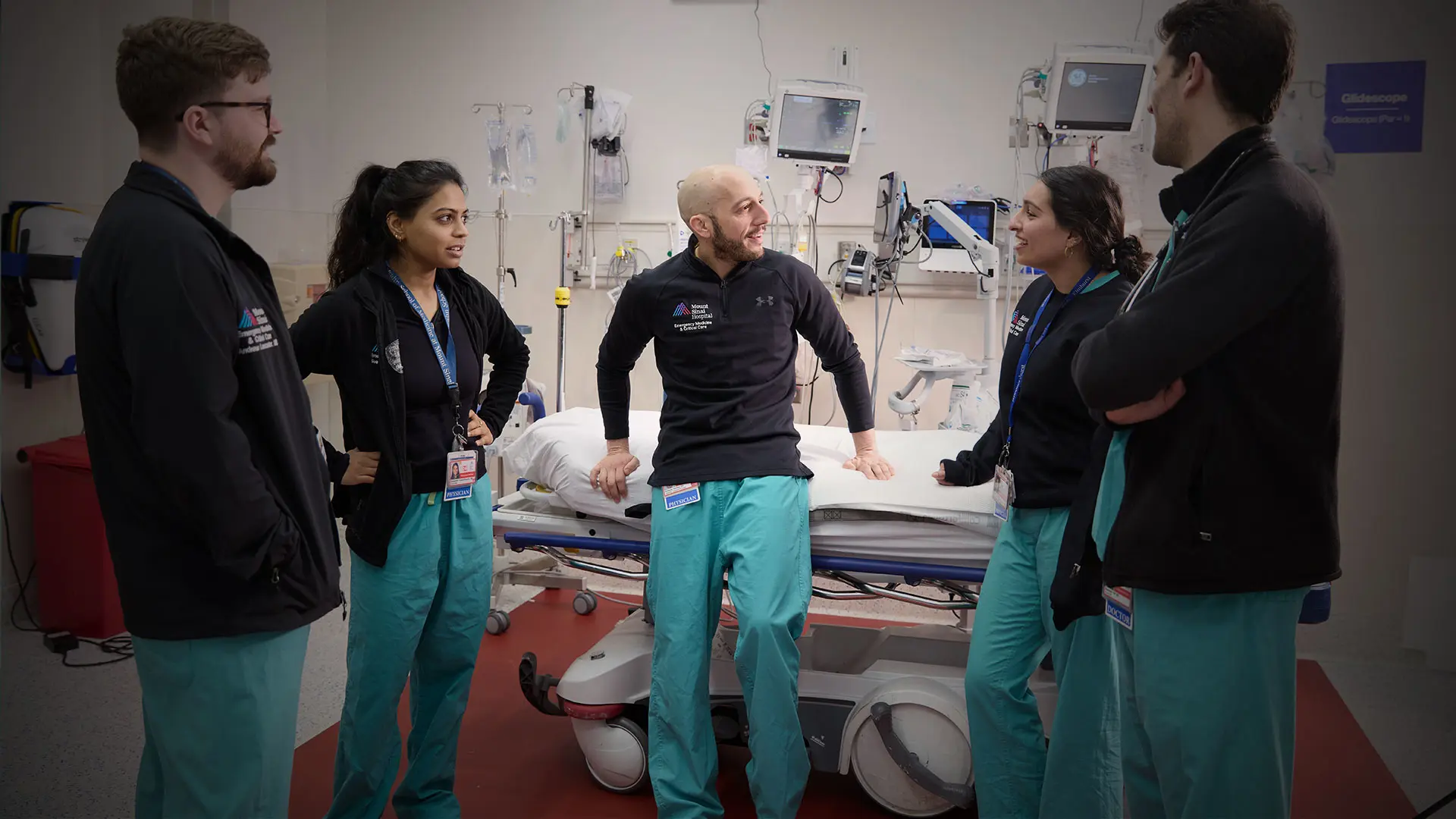
The division of emergency medicine (EM) and critical care medicine (CCM) training into separate tracks has long seemed impractical to some leaders in the field. A few years ago, Anthony Devivo, DO, took charge of The Mount Sinai Hospital Emergency Department's efforts to address this.
Recognizing that critical care is deeply ingrained and entrenched in the training and practice of emergency medicine, Dr. Devivo, who is certified in both emergency medicine and critical care, led the launch of the nation’s first combined Emergency Medicine-Critical Care Medicine (EM-CCM) Residency Program at the hospital in July 2025.
“Traditionally, we train the emergency resuscitationist and diagnostician first and then, once that is complete, pursue training that individual to also be a systems-based intensivist focused on meticulous management of critical care,” says Dr. Devivo, Assistant Professor of Emergency Medicine at the Icahn School of Medicine at Mount Sinai.
“Instead of training the brain in these specialties separately and disjointedly, I thought it would be smarter and more efficient to develop a program that trains individuals in these specialties at the same time,” he adds.
Offered as a track under the hospital’s Residency in Emergency Medicine program, the five-year EM-CCM program is operating as a pilot with two cohorts—two interns and two PGY2 residents who applied for the program during their intern year as EM residents. It is one of two Mount Sinai residency programs that tightly link emergency medicine with critical care.
“We have created a new paradigm that delivers training simultaneously throughout the five years to provide a more longitudinal educational experience,” says Dr. Devivo. “It is my hope that this also encourages future EM-intensivists to incorporate and practice both specialties throughout their careers.”
Development of the combined EM-CCM was facilitated in large part by the existing EM residency program’s focus on critical care training. Residents in that program start dedicated shifts in the Emergency Department's dedicated critical care areas in their second year, seeing patients one on one with an attending. This approach, which informs the combined EM-CCM, differs from that of other programs, in which residents see critical care patients occasionally during their usual ED shifts but without focused time.
The program continues a commitment to innovation that began in 1995 with the establishment of the Department—the first academic emergency medicine department in Manhattan. As the only program of its kind nationwide, the combined EM-CCM has garnered considerable interest from trainees and medical centers alike. Applications for the program’s third cohort have significantly eclipsed the two available positions, and other institutions are increasingly asking for advice on starting similar initiatives.
Elaine Rabin, MD, is encouraged by this response. As Program Director for the hospital’s four-year Residency in Emergency Medicine program, she supported Dr. Devivo at every stage of this undertaking, from curriculum development to securing approval from the American Board of Emergency Medicine and the American Board of Internal Medicine. Although the process involved administrative challenges, she says several factors worked in the hospital’s favor.
“We have a track record of hiring and integrating faculty with training in both emergency medicine and critical care,” says Dr. Rabin, Associate Professor of Emergency Medicine at the Icahn School of Medicine at Mount Sinai.
“We also have a long history of training residents who are interested in critical care and helping them secure their first choice in critical care fellowships. Given that success and our success in training ICU grads at the fellowship level, it was not a stretch for us to combine the two.”
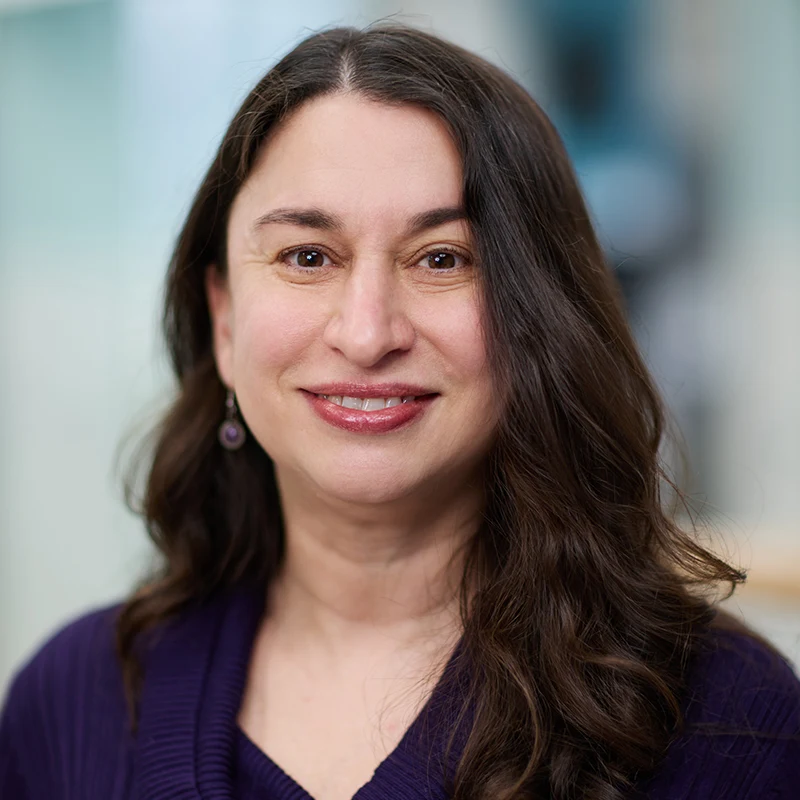
As the overall residency program director, Dr. Rabin was a key supporter of the department's efforts to create a joint emergency medicine-critical care fellowship.
Dr. Rabin believes a willingness to innovate has helped distinguish the hospital’s four-year Residency in Emergency Medicine program in ways that offer residents an enhanced training experience. Under her leadership, there has been increased focus on career development in the third and fourth years through mentorship and elective opportunities. The goal is to ensure residents gain expertise and exposure in areas of emergency medicine that interest them, such as ultrasound or addiction medicine.
“Our residents are highly successful in terms of both fellowship and job placements based on the strength of our training,” Dr. Rabin says. “They are often hired for jobs in academic systems that only hire individuals who are fellowship-trained, either starting out in, or working their way into, leadership positions with those institutions.”
On the West Side of Manhattan, a three-year program at Mount Sinai West has achieved similar success, consistently matching graduates with their first choices for critical care fellowships and employment. Chen He, MD, Program Director, attributes this to a didactic approach that emphasizes graduated responsibility.
“We have heard from community organizations and high-acuity, high-volume centers that our trainees have been able to hit the ground running because they have learned how to manage teams from an early point in their residencies,” says Dr. He, Assistant Professor of Emergency Medicine at the Icahn School of Medicine. “I believe that dedication to graduated responsibility training is relatively unique among emergency residencies.”
Dr. He adds that the program is further distinguished by the exposure residents receive to critical care, particularly those in their third year. These residents are tasked with leading intensive care unit teams, which she says is unusual among emergency medicine residency programs.
“Typically, interns and junior residents are sent into the intensive care unit as junior residents,” Dr. He says. “By giving our third-year residents leadership roles where they are responsible for patient decision-making as well as the supervision and teaching of junior residents on every shift, we are ensuring they are clinically prepared to be independent attendings.”
Although The Mount Sinai Hospital and Mount Sinai West emergency medicine residency programs are separate entities, they are connected through shared research presentations, a systemwide quarterly conference, and a commitment to outstanding training through ongoing enhancement. Dr. He is interested in creating more robust elective options for residents, such as telemedicine and community paramedicine, as well as new rotation opportunities, such as observation medicine. Dr. Rabin is open to exploring other EM tracks, potentially once the combined EM-CCM becomes a standalone, formalized training pathway approved by the Accreditation Council for Graduate Medical Education.
“Our goal is to train very strong emergency medicine physicians, and we hope the resources we are putting into the EM-CCM program will enhance the critical training we deliver through the Residency in Emergency Medicine program,” Dr. Rabin says.
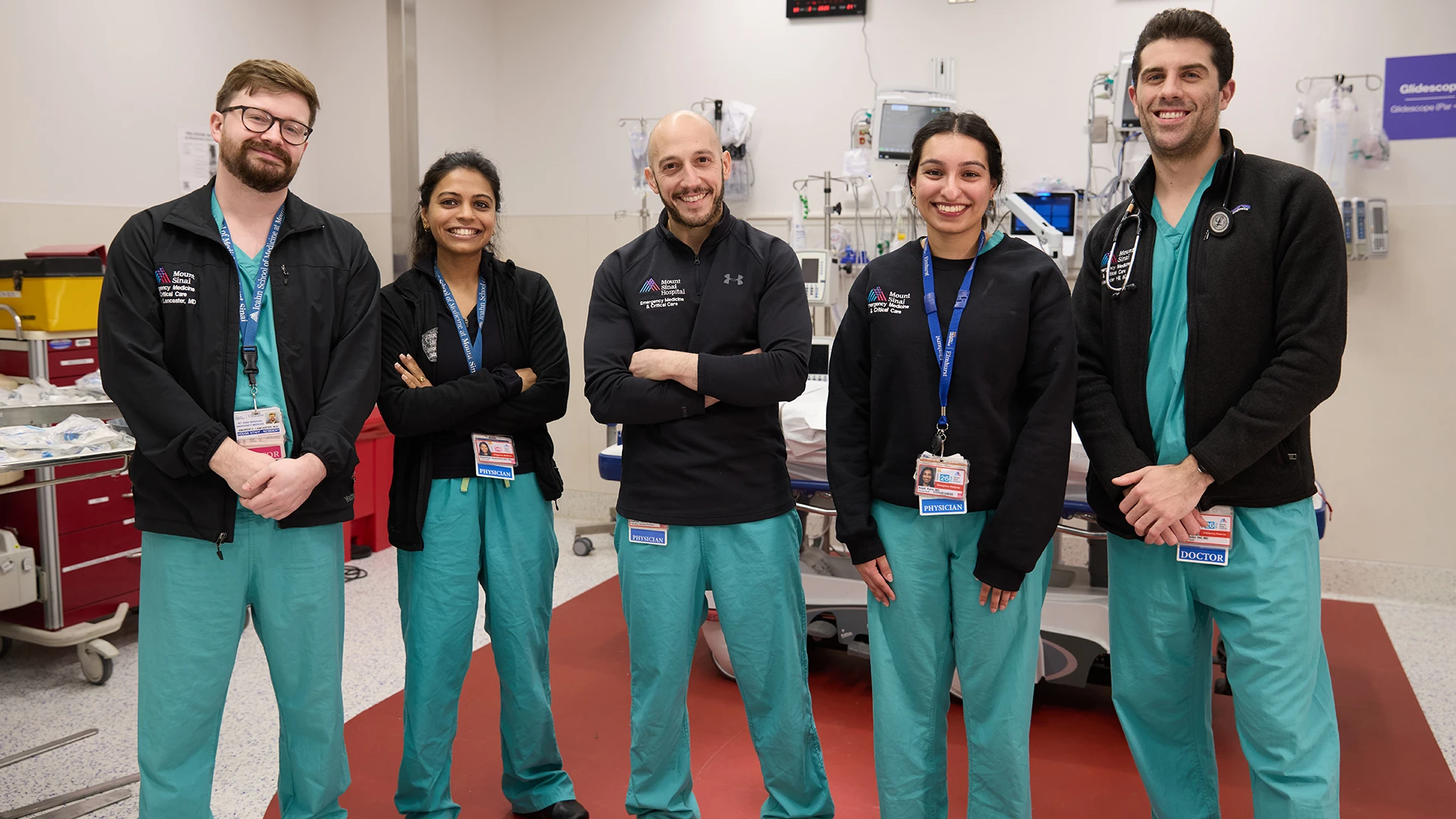
Dr. Devivo, center, with fellows, from left: Andrew Lancaster, MD; Siva Rajamarthandan, MD; Anjali Kalra, MD; Alexander Hill, MD